The Real Benefits of Kids Playing at Playgrounds: What Your Child Gains Every Time They Visit
Quick Answer: Playground play builds strength, balance, and coordination; teaches social skills like sharing and turn-taking; supports emotional regulation through risk and independence; and boosts cognitive skills like problem-solving and imagination — all through unstructured, child-led movement that’s hard to replicate indoors or through screens.
You watch your kid fly down the slide for the tenth time and think — is this actually doing anything, or am I just killing time until dinner?
The answer is yes: playground time is doing something. A lot, actually. When your child climbs, swings, and runs across the grass, they’re not just having fun. They’re building neural pathways, developing muscle control, learning how to navigate conflict, and practicing problem-solving without you saying a word.
But the thing is, if you treat playgrounds like babysitting, you won’t see the full value. Understanding what your child is actually gaining at the playground makes you more likely to prioritize it — and it helps you choose equipment that matches what your child needs to learn right now.
By the end of this article, you’ll know exactly what developmental skills each piece of playground equipment builds, how much time actually matters, and how to build playground visits into your routine even when you’re exhausted.
Heads up: This post may include affiliate links. As an Amazon Associate, I earn from qualifying purchases—at no extra cost to you. Full privacy policy and disclosure here.
The Physical Benefits of Playground Play
The most obvious thing playgrounds do is move kids’ bodies. But the specific ways they move matters. Every piece of equipment is training a different set of muscles and motor skills.
How Climbing Builds Strength and Coordination
Climbing is the playground’s strongest tool for physical development. When your child scales a climbing wall, uses monkey bars, or scrambles up a rope ladder, they’re engaging almost every muscle in their body. Climbing builds grip strength, core stability, and the confidence that comes from knowing their body can do hard things.
Beyond just strength, climbing teaches your child to think spatially. They have to figure out where to place their hands and feet, how to adjust their weight, and how to solve the problem of getting from bottom to top. This builds the brain-body connection called proprioception — the sense of where your body is in space.
Climbing also teaches risk assessment in a contained way. Your child learns (on their own timeline) what feels scary, what’s manageable, and what they’re ready for. This is the exact kind of experience that builds resilience.
Swinging, Balance, and the Vestibular System
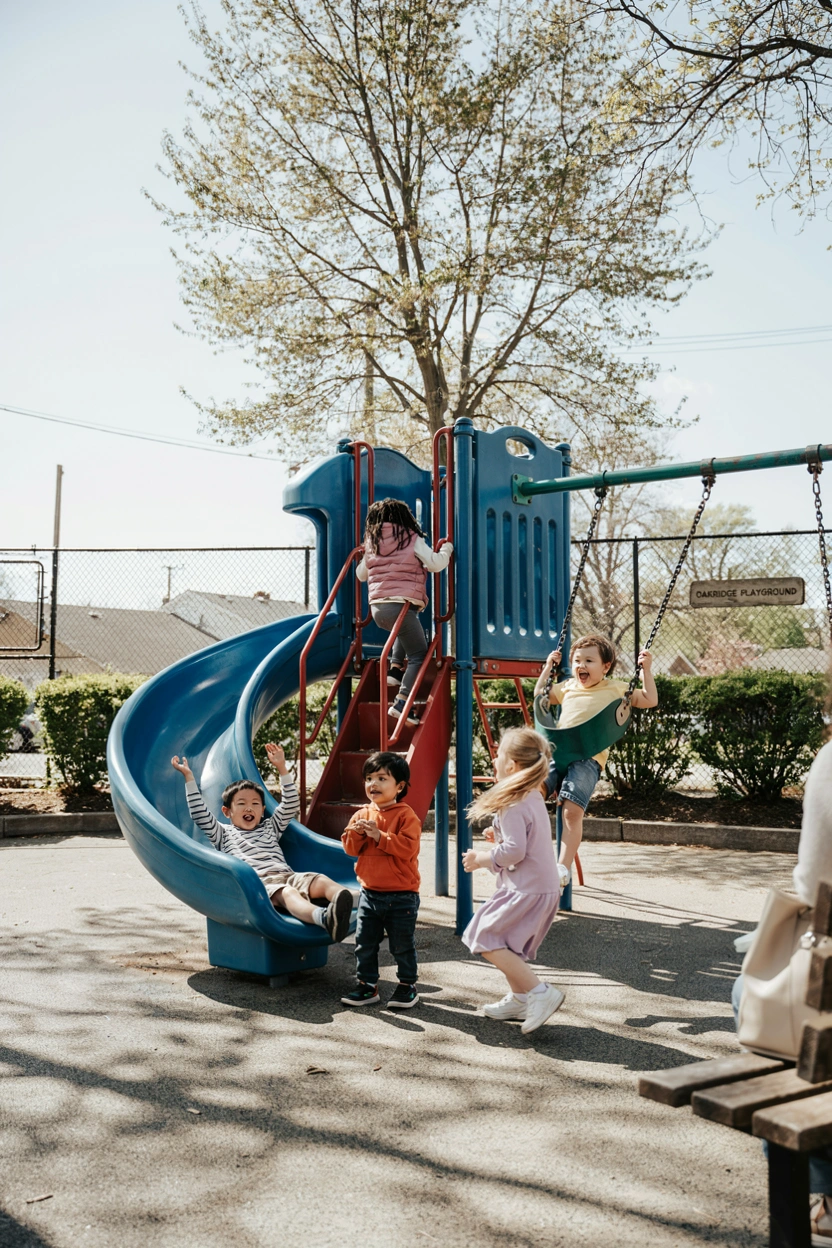
The vestibular system is the inner ear mechanism that controls balance, spatial awareness, and coordination. Swinging activates it powerfully. Every pump of the legs, every push forward and back, is training your child’s sense of rhythm, timing, and body control.
Balance-focused equipment like balance beams or stepping logs develops the same skills. These pieces are especially important for younger toddlers who are still figuring out how their bodies work. Regular balance practice translates directly to better coordination in running, dancing, and sports later.
Slides offer a gentler vestibular workout through speed and direction changes. The moment of sitting at the top and sliding down teaches your child that their body can move fast and still be safe — important for fearlessness and confidence.
The Social Benefits: How Playgrounds Teach Kids to Get Along
Playgrounds are also social training grounds. They’re one of the first places kids practice sharing, turn-taking, and working through conflict without a parent solving it for them.
Learning to Share and Take Turns
At the playground, there’s only one slide, one swing, one climbing structure. Multiple kids want it at the same time. Your child has to learn to wait. They have to negotiate (“Can I go after you?”). They have to handle disappointment when it’s not their turn.
These lessons don’t come from instruction. They come from experiencing natural consequences. A child who hoards the swing will be avoided by other kids. A child who pushes in line won’t be included in group play. The feedback is immediate and real.
This is the kind of social learning that builds naturally on the playground in a way it can’t at home or in a structured class.
Navigating Conflict Without a Parent Stepping In
The playground is where your child practices conflict resolution without you mediating. Two kids both want the swing. One child knocked over another’s sandcastle. Someone grabbed the ball. These tiny conflicts teach your child how to advocate for themselves, read social cues, and find solutions.
The magic happens when you resist the urge to jump in. Letting your child work through small conflicts builds competence and confidence in a way no parent intervention can. They learn that they can handle hard social moments. They learn that other kids won’t hate them if there’s a disagreement. They learn negotiation.
These are skills that matter far more than any academic lesson in second grade.
The Emotional Benefits: Confidence, Independence, and Managing Risk
Perhaps the biggest gift playgrounds give is emotional development. The playground is where your child learns courage, independence, and a healthy relationship with risk.
Why Risky Play (Climbing High, Going Fast) Is Good for Kids
Risky play is unsupervised, challenging physical activity where a child might get hurt but usually doesn’t. It includes climbing high, swinging fast, jumping from heights, and exploring without a safety net. It sounds scary, but it’s exactly what kids need.
Children who engage in risky play develop better risk assessment skills. They learn the difference between dangerous (jumping off a three-story building) and adventurous (climbing to the top of a tall structure). Over time, kids who’ve been allowed to take physical risks become more cautious and thoughtful, not less. They understand their limits because they’ve tested them.
Risky play also builds confidence. Every time your child does something that scares them and discovers they’re okay, they add to their sense of capability. A child who climbs to the very top of the climbing structure learns something powerful: they can do hard things.
This confidence transfers. A child who’s conquered the big slide tends to approach new challenges with more optimism. The playground becomes a confidence factory.
The emotional regulation piece matters too. A child who’s anxious or overwhelmed can go to the playground, burn physical energy, and reset their nervous system. Running, swinging, and climbing are all forms of physical regulation that help kids process stress and emotion.
The Cognitive Benefits: Problem-Solving and Imagination
The playground isn’t just physical and social — it’s deeply cognitive. Unstructured play is where imagination happens, and imagination is foundational to every form of learning.
When your child has free time at the playground without a structured activity, their brain fills the void with games. Two kids become superheroes saving a city. A sandbox becomes a bakery. The climbing structure turns into a fort. This kind of imaginative play is how kids process the world, work through anxieties, and develop creativity.
Playgrounds also teach problem-solving in real time. How do I get down from here? How do I convince my friend to play my game? What if I try this? Kids are constantly making decisions, testing hypotheses, and adjusting based on results. This is the essence of learning.
The open-endedness of playground play is what makes it cognitively rich. A single piece of equipment can be used a hundred different ways. There’s no one right way to play, so kids have to think.
Playground Benefits by Age and Equipment: The Complete Reference Table
This table is your guide to understanding what specific skills each piece of equipment builds at each age. Use it to make sure your child has access to a variety of playground experiences.
| Age Group | Equipment Type | Primary Skills Built | Why It Matters |
|---|---|---|---|
| Toddler (12–24 months) | Slide (shallow angle) | Body awareness, sequencing, climbing into and down from structure | Builds confidence that their body can move safely; introduces the concept of “up” and “down” |
| Toddler (12–24 months) | Swing | Vestibular input, rhythm, rhythm anticipation | Calming for nervous systems; builds prediction skills (“What comes next?”) |
| Toddler (12–24 months) | Sand/water play area | Sensory exploration, fine motor skills (scooping, pouring), imaginative play | Early cognitive and sensory development; opportunities for parallel play alongside other kids |
| Preschooler (2–4 years) | Climbing structure (low-to-medium height) | Gross motor skills, strength, balance, spatial awareness, mild risk-taking | Builds confidence in physical capability; develops proprioception |
| Preschooler (2–4 years) | Slide (medium angle) | Sequencing, spatial relationships, mild speed/thrill | Expands understanding that their body can move faster; social (turn-taking with other kids) |
| Preschooler (2–4 years) | Swing (standard) | Vestibular system, self-regulation, anticipation, coordination | Provides regulation for dysregulation; builds prediction skills |
| Preschooler (2–4 years) | Seesaw/teeter-totter | Cooperation, timing, coordination with a peer, balance | Requires collaboration; teaches that actions affect others |
| School Age (5–8 years) | Tall climbing structure | Risk assessment, problem-solving, grip strength, persistence, confidence | Supports development of healthy risk-taking; builds resilience when a climb feels hard |
| School Age (5–8 years) | Monkey bars | Upper body strength, grip control, cross-body coordination, hand-eye coordination | Builds strength that transfers to sports and physical confidence |
| School Age (5–8 years) | High slide | Risk-taking in controlled context, courage, speed awareness | Supports development of healthy bravery; builds feedback about body speed control |
| School Age (5–8 years) | Open sand/loose parts area | Imaginative play, collaboration, long-form play narratives, engineering | Unstructured area supports deep cognitive engagement and peer interaction |
Use this table to notice patterns in your child’s play and make sure they have access to a mix of equipment. A child who only swings is missing out on climbing. A child who never engages with loose parts (sand, water, sticks, rocks) is missing out on imaginative play.
[PRINTABLE SUGGESTION: This table would make an excellent downloadable reference card for parents and caregivers]
How Much Playground Time Do Kids Actually Need?
The American Academy of Pediatrics recommends that children ages 3 and older get at least 60 minutes of physical activity daily. For younger toddlers, active play throughout the day is what matters most — no specific minute requirement, just frequent opportunities to move.
The playground doesn’t have to provide all 60 minutes. But it’s one of the most efficient ways to get unstructured physical play. A 30-minute playground visit plus other daily movement (walking to school, playing in the yard, chase games at home) easily meets the guideline.
More importantly: consistency matters more than duration. A child who goes to the playground three times a week for 20 minutes gets more benefit than a child who goes once a month for two hours. The regular habit builds skills incrementally.
If 60 minutes feels impossible with your schedule, remember that even 15 minutes of playground time is better than no playground time. You don’t need a perfect amount. You need a rhythm.
Playground Play vs. Screen Time
Here’s the comparison parents actually want:
| Skill or Outcome | Playground Play | Screen Time |
|---|---|---|
| Physical strength and coordination | Builds actively through movement against gravity | Minimal; static posture |
| Gross motor skill development | High — climbing, running, balancing, jumping all train motor control | None |
| Vestibular/balance development | Constant input through varied movement | None |
| Risk assessment and resilience | High — real consequences teach real lessons | None — simulated risks don’t build real confidence |
| Social skill development | High — peer interaction, negotiation, conflict-solving | Low — even “social” games reduce direct interaction |
| Emotional regulation | Physical activity reduces anxiety and improves mood | Can increase anxiety and sleep disruption |
| Imagination and creative thinking | Child-led and endless | Passive consumption of someone else’s ideas |
| Problem-solving in real time | Constant: “How do I climb this? What do we play?” | Passive: someone else’s solution plays out |
| Sleep quality | Physical activity improves sleep quality | Screen light disrupts melatonin; can harm sleep |
Neither is terrible in moderation, but they’re not interchangeable. An hour of screen time will never give your child what 30 minutes at the playground does. The comparison itself is telling.
Making Playground Time Part of Your Routine
Here’s the truth: you won’t prioritize playgrounds unless you make them a habit. Motivation fades. Busy schedules crowd them out. Energy is limited.
But a routine changes everything. A routine means you don’t have to decide. It just happens.
Pick a recurring time slot. Tuesday and Thursday afternoons. Saturday mornings. After school three days a week. Whatever rhythm actually fits your life. Write it on your calendar like any other appointment.
Prepare for bad weather. Invest in weather-appropriate gear so rain and cold don’t cancel playground plans. Weather-appropriate kids’ outdoor jackets, rain boots, and hats exist for a reason — they remove the barrier. When you have the gear, you’re more likely to go.
Keep expectations low. You’re not there to teach or structure. Bring a book or just watch the world. Your child’s job is to play. Your job is to be present enough that they feel safe exploring.
Build in a routine within the routine. Arrive at 3 pm, sand play for 15 minutes, climbing structure for 10, swing for 10, snack at the picnic table. Kids thrive on knowing what’s coming. It sounds rigid, but it actually makes spontaneous play easier because their brain knows the structure.
Start a playground buddy system. Meeting a friend there makes it more fun for your kid and more sustainable for you. Shared entertainment is stronger motivation than solo obligation.
Frequently Asked Questions
Are playgrounds good for toddlers, or should I wait until they’re older?
Toddlers benefit enormously from playgrounds. Even a 12-month-old can climb a shallow structure, go down a slide, or play in sand. Early playground exposure builds physical confidence and introduces the joy of movement. Age-appropriate equipment matters — toddler playgrounds with lower structures are ideal — but waiting until school age means missing crucial developmental windows.
How many hours of outdoor play do kids need per day?
The American Academy of Pediatrics recommends at least 60 minutes of physical activity daily for children ages 3 and up. Not all of this needs to be at a playground. Walking, yard play, and structured sports count. But having a regular playground routine ensures your child gets consistent, high-quality unstructured movement.
Is risky play (like climbing high) actually safe for kids?
Yes, and the research supports it. Children who engage in risky play under normal playground conditions — with proper supervision but without over-protection — actually develop better safety awareness and fewer serious injuries over time. They learn to assess risk accurately because they’ve tested their limits. Preventing all risk doesn’t build resilience; it builds anxiety.
Do playgrounds help kids who struggle socially?
The playground can be healing for socially anxious kids. The unstructured nature means there’s no “wrong way” to participate. A shy child can play alone in the sand and still benefit socially. Over time, parallel play often turns into interaction. Playgrounds don’t force social engagement — they create the conditions where it can happen naturally.
What’s the best playground equipment for building confidence?
Climbing structures win. The ability to get high, solve the problem of descent, and realize their body is capable builds confidence faster than almost any other equipment. Swings are close seconds for emotional regulation. Combination structures with varied heights and challenges are ideal because kids can choose their challenge level and advance at their own pace.
Can playground play replace structured sports?
They serve different purposes. Playground play builds foundational physical confidence, social skills, and joy in movement. Structured sports add rules, teamwork, and goal-oriented challenge. For younger kids, playground play is more developmentally important. Sports can come later.
Do playgrounds help kids with sensory processing challenges?
Yes, but it depends on the playground. Kids with sensory needs benefit from climbing (proprioceptive input), swinging (vestibular input), and sand play (tactile input). Some kids need quieter areas. Others need loose parts. The variety of sensory experiences at a typical playground is harder to replicate indoors.
What age can kids use playground equipment unsupervised?
Supervision requirements depend on the child, the playground, and your local norms. Most safety experts recommend direct supervision for children under 5. School-age children can often handle more independence, especially if they’re at a familiar playground. The transition happens gradually — you might sit closer and supervise more loosely over time as they prove their judgment.
Does playground time really compare to screen time in terms of development?
Not even close. A child’s physical, social, emotional, and cognitive development happens through playground play in ways screens simply cannot replicate. This isn’t a value judgment on screens — they have their place. But they’re not a substitute. They’re entirely different activities with entirely different outcomes.
How do I get my reluctant or anxious child to enjoy the playground?
Start small. A nervous child might need 10 minutes near the sandbox before they’re ready to try the slide. Don’t push. Your calm presence matters more than their activity level. Some children need multiple visits to feel safe. Let them set the pace. Celebrate small bravery without pressure. Over time, repeated exposure in a low-pressure environment builds confidence.
Conclusion: The Playground Is Not Babysitting — It’s Development
The playground isn’t just a place to tire out your kid so they’ll nap. It’s one of the most important developmental environments childhood offers. Every visit builds strength, social skills, emotional resilience, and cognitive capacity in ways that nothing else can replicate.
If you’re exhausted and feel guilty that you’re not doing “enough,” regular playground time counts. It counts a lot. A tired mom who takes her kid to the playground three times a week is doing something genuinely powerful for their development.
Start small. Pick one time slot that works. Commit for a month. Notice what your child discovers. Then notice what changes in how confident, capable, and resilient they become. That’s the playground at work.
Want more ideas for supporting your child’s development at home? Check out our guide to summer sensory activities for toddlers and our complete resource on how to create a baby play area at home. Both complement playground play beautifully.
Suggested Sources for Further Reading
- American Academy of Pediatrics: Pediatricians want all families to be physically active for life — cited for the 60-minute daily activity recommendation for children ages 6+.
- Ellen Beate Hansen Sandseter: Children’s Risky Play From an Evolutionary Perspective — cited for research on how manageable risky play builds coping and risk-management skills in children.
- Observational Research: Risky Play and Children’s Well-Being, Involvement and Physical Activity — cited for evidence that risky play is positively associated with children’s wellbeing and physical activity levels.
- Canadian Paediatric Society: Healthy childhood development through outdoor risky play — cited for research on outdoor free play’s physical, mental, and social-development benefits, and the importance of balancing safety with manageable risk.