

How to Stop a Child From Hitting Others: A Developmental Guide for Frustrated Parents
Quick Answer: Hitting is developmentally normal in toddlers and preschoolers, especially between ages 18 months and 4 years. Stay calm, set a clear boundary immediately, use simple language (“Gentle hands”), validate their feeling, redirect to a safe outlet, and praise gentle play. Most children significantly reduce hitting by age 4 with consistent coaching.
Your kid just smacked their brother. Your face is hot. You’re embarrassed. Is this normal?
Yes. And also—you’re handling it right by being here, looking for answers.
Hitting is a common part of early childhood development, particularly between 18 months and 4 years, as young children are still learning self-control, communication, and emotional regulation. Source: American Academy of Pediatrics. At the same time, it’s one of the most anxiety-inducing for parents. You worry about judgment from other caregivers. You worry your child is aggressive. You worry you’re doing something wrong. The truth is simpler: your child’s brain is still developing the skills needed for impulse control, emotional regulation, and communicating big feelings with words instead of physical actions. Source: American Academy of Pediatrics
This guide walks you through why kids hit at different ages, how to respond in the moment, age-specific strategies that actually work, and—most importantly—when hitting is developmentally normal versus when you should reach out to a professional. By the end, you’ll know exactly what to do, what to say, and whether you need to worry.
Heads up: This post may include affiliate links. As an Amazon Associate, I earn from qualifying purchases—at no extra cost to you. Full privacy policy and disclosure here.
Why Do Kids Hit? The Developmental Reality
Before you can stop hitting, you need to understand why it’s happening. Kids don’t hit to be mean or because you’re doing something wrong. They hit because their brains are still under construction.
Young children often hit because the parts of the brain responsible for self-control and emotional regulation are still developing—not because they are intentionally being mean or defiant. Source: American Academy of Pediatrics
Toddlers (18 months to 2.5 years): Impulse Control Is Nonexistent
During the toddler years, the parts of the brain responsible for impulse control, planning, and decision-making are still developing, which is why young children often act before they think. Source: Harvard Center on the Developing Child. This means they literally cannot stop themselves from hitting the way an older child can.
Toddlers hit for predictable reasons: frustration (they want something and can’t have it), excitement (they’re so happy they don’t know what to do with their body), tiredness or hunger (dysregulation), or cause-and-effect curiosity (hitting mom makes mom react—interesting!). They have no words for “I’m frustrated” or “I’m excited,” so their hands do the talking.
Toddlers learn best through calm, consistent guidance, immediate redirection, and simple language rather than punishment or lengthy explanations. They also benefit from safe outlets for physical energy. Source: American Academy of Pediatrics
Preschoolers (2.5 to 4 years): Impulse Control Is Developing (Slowly)
Around age 2.5 to 3, something shifts. Your child’s vocabulary explodes. Their ability to understand consequences begins to emerge. They can follow simple rules. But impulse control is still fragile—they can stop themselves sometimes, but not always, and not under stress.
Preschoolers hit for many of the same reasons as toddlers, but now there’s an added layer: they’re testing social power. They hit to see if it gets a reaction. They hit when frustrated because they still don’t have enough emotional vocabulary. They hit other kids because they’re learning social skills and still don’t understand “gentle” versus “rough.”
This age group is starting to respond to teaching. They can learn to use words, problem-solve, and understand that hitting hurts. This is when your coaching begins to pay off.
Older Preschoolers (4 to 5 years): Impulse Control Is More Reliable, But Still Not Adult-Like
By around age 4, many children have developed better impulse control and are more able to manage frustration without hitting, although occasional aggressive behavior can still occur. Source: American Academy of Pediatrics. If your child is still hitting frequently at this age, it may indicate difficulty with emotion regulation, social skills, or impulse control that warrants a conversation with your pediatrician. But occasional hitting during conflict or frustration is still within normal range.
Kids this age hit less often but may hit harder—they have more physical power and sometimes less inhibition about using it. They also become more aware of social consequences, which can actually work in your favor. Gentle reminders about how their actions affect others start to land.
Is Hitting Normal or a Red Flag? The Decision Tree
You’re probably asking: Is this normal, or do I need to worry? Here’s how to figure it out.
Most hitting is developmentally normal. But some hitting signals that your child needs extra support or professional guidance. Use this checklist to figure out where your child falls:
The “Is My Child’s Hitting Normal?” Checklist
Answer yes or no to each question:
- My child is between 18 months and 4 years old.
- The hitting happens mostly when frustrated, overtired, overstimulated, or excited.
- My child sometimes stops themselves or responds to redirection.
- The hitting is not causing injury (no marks, bruises, or blood).
- My child has other ways of playing and interacting (not hitting all the time).
- The hitting has decreased somewhat over the past 3–6 months or is not getting significantly worse.
- My child responds to comfort after hitting (they’re not aggressively seeking confrontation).
If you answered yes to most of these: Your child’s hitting is likely developmentally normal. Keep reading for age-specific strategies.
If you answered no to several of these (especially if your child is over age 4, hitting causes injury, is getting worse, or shows no response to redirection): Schedule a check-in with your pediatrician. Persistent, escalating, or injury-causing hitting can signal sensory needs, difficulty with emotional regulation, or other developmental considerations that benefit from professional input.
When Sensory Issues Might Be Playing a Role
In some children, hitting may be related to sensory-seeking behaviors rather than intentional aggression, particularly if they frequently seek strong physical input or movement. Source: American Academy of Pediatrics. Some children hit (or pinch, or squeeze) because they’re seeking deep proprioceptive input. Their nervous system is hungry for that feedback.
If your child hits in seemingly random moments, doesn’t seem emotionally upset when hitting, and also seeks intense physical play, deep hugs, or jumping on the couch—sensory needs may be part of the picture. This doesn’t mean something is wrong. It means your child needs safe outlets: a punching bag, a “crash pad,” jumping activities, or wrestling play with clear rules.
If you notice frequent sensory-seeking behaviors alongside persistent hitting, talk with your child’s pediatrician, who can determine whether additional evaluation or support, such as occupational therapy, may be helpful. Source: American Academy of Pediatrics
What to Do Right When Your Child Hits
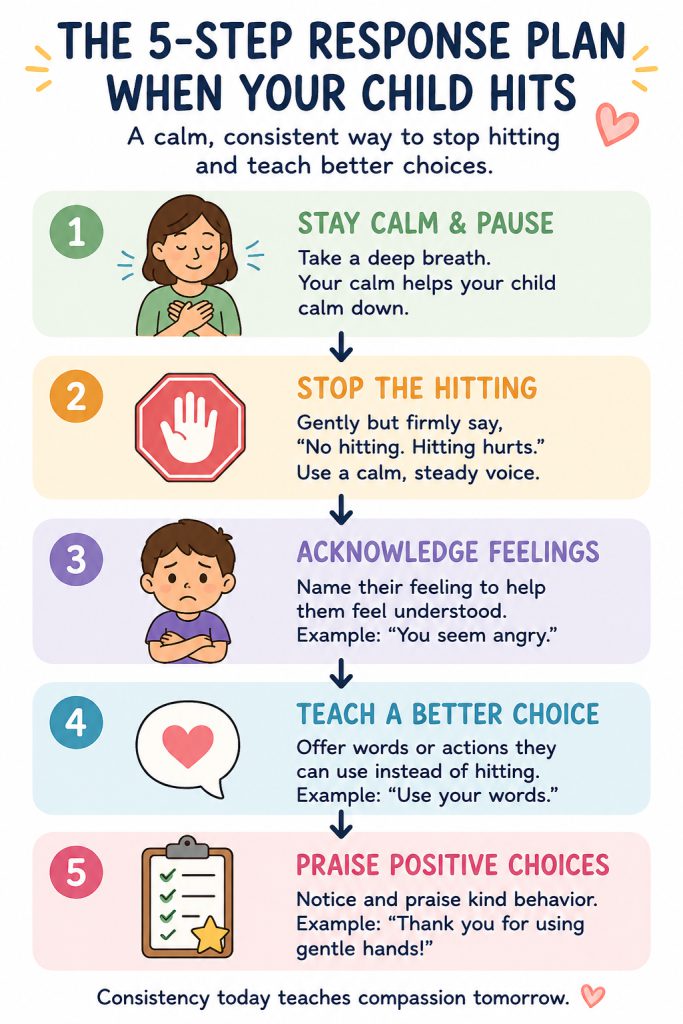
This is the section you actually need. Here’s your step-by-step response—and the exact phrases to use.
Step 1: Stay Calm (Your Regulation First)
This is the hardest step. When your child hits—especially if they hit you—your adrenaline spikes. You’re embarrassed. You’re frustrated. You want to react.
Don’t. Your child is watching your nervous system. If you explode, their nervous system gets more dysregulated. If you stay calm, you’re teaching them how to handle big feelings.
Take a breath. Count to three. If you need to step away for 10 seconds, do it. Your calm is the most powerful teaching tool you have.
Step 2: Stop the Behavior Immediately
Move your child’s hand, step back, or use your body to create distance. Be matter-of-fact, not angry.
What to do: Gently but firmly hold their hand or move them away. Use a calm voice.
What not to do: Avoid hitting back or using physical punishment, as research shows these approaches do not improve long-term behavior and may increase aggressive behavior over time. Source: American Academy of Pediatrics. Don’t yell or shame (“Big kids don’t hit!” or “You’re being so bad!”). Don’t give a long lecture.
Step 3: Name the Feeling and Set the Boundary
Now use your words. Keep it simple—under 10 words. Your child cannot process a paragraph while dysregulated.
Use this formula: “I see you’re [FEELING]. Gentle hands. Hitting hurts.”
Real examples:
- “You’re frustrated. Gentle hands. I won’t let you hit.”
- “You’re excited. We use gentle touches.”
- “You’re angry. Hitting is not okay. Your words help.”
What not to say:
- “Why would you do that?” (They don’t know. Their brain isn’t able to stop the impulse yet.)
- “Say sorry.” (Forced apologies teach kids to fake emotions, not learn.)
- “You’re being mean / bad / naughty.” (This is shaming, not teaching.)
- “If you do that again, I’ll…” (Threats escalate dysregulation.)
Step 4: Redirect or Separate if Needed
Depending on your child’s age and the situation, you either redirect them to a safe outlet or separate them from the trigger.
For toddlers (18 months–2.5 years): Redirect immediately. Move them away from the person they hit and toward something physical they can do instead: “Let’s jump on the couch” or “Go stomp to the kitchen.”
For preschoolers (2.5–4 years): Offer choices. “Your hands need something to do. Do you want to punch the pillow or jump on the trampoline?” This helps them burn the energy while learning that hands can do other things.
For older kids (4–5 years): Ask them to problem-solve. “Hitting isn’t safe. What should you do instead?” This builds their skills. If they can’t answer, give options: “You could ask for help, take a break, or do some jumping.”
Step 5: Reconnect and Problem-Solve
Once your child has calmed down, reconnect. This is where the learning happens—not in the heat of the moment.
A simple hug, “I see you’ve calmed down,” or sitting nearby while they play signals that you’re not mad and the relationship is secure. For older preschoolers, you can add a brief conversation: “That was hard. What made you so angry? Next time, what could you try?”
Don’t make this a long discussion. Kids learn from repetition and consistency, not from one big talk.
Age-Specific Strategies That Actually Work
Here’s the truth your parenting books don’t say: the strategy that works at age 2 does not work at age 4. A 2-year-old cannot problem-solve. A 4-year-old cannot impulse-control the way an adult can. Different ages need different tools.
Use the matrix below to find your child’s age and the approach that actually matches their development:
| Age Group | Main Triggers | Why They Hit | Most Effective Response |
|---|---|---|---|
| 18–24 months | Frustration, excitement, tiredness, cause-and-effect curiosity | No impulse control yet; words are limited; testing what their body can do | Immediate redirection to a safe outlet (jumping, throwing a ball, pushing a toy). Repeat simple phrases (“Gentle hands”). Avoid power struggles. Their brain literally can’t stop themselves yet. |
| 2–2.5 years | Frustration with not being understood, excitement, testing boundaries, conflict over toys | Still developing impulse control; vocabulary is growing but not enough to express big feelings; learning about power and control | Validate the feeling (“I see you’re frustrated”). Redirect to safe outlet. Offer choices between two safe options. Start teaching simple words for feelings. Redirect, don’t lecture. Expect this to happen frequently—it’s developmentally normal. |
| 2.5–3 years | Frustration with limits, conflict with peers, excitement, wanting control | Impulse control is fragile but beginning; they can understand simple cause-and-effect; testing social boundaries | Stay calm and set boundaries consistently. Use feeling words (“You’re angry—that’s okay. Hitting is not”). Redirect to safe outlet. Begin teaching words for feelings and problem-solving (“Use your words—ask for help”). Praise gentle play and cooperation heavily. |
| 3–4 years | Frustration, conflict with peers, wanting control, not getting their way | Impulse control is more reliable but still developing; they understand rules and consequences; social skills are developing | Set clear boundaries. Ask them to problem-solve (“What should you do instead?”). Teach emotion regulation skills (deep breaths, “use words,” asking for help). Redirect to safe outlets. Acknowledge their feelings while enforcing the rule against hitting. Pair with positive reinforcement when they handle frustration without hitting. |
| 4–5 years | Frustration, conflict, losing at games, not getting their way | Should be able to stop themselves most of the time; have language for feelings; understand social consequences | Use natural consequences (“If you hit, we need to take a break from that activity”). Help them identify triggers and problem-solve (“What made you hit? What could you do next time?”). Build emotion regulation skills. If hitting is still frequent or getting worse, check in with your pediatrician about possible sensory, anxiety, or regulation needs. |
Toddler Strategies: Redirect, Redirect, Redirect
Your 18-month to 2-year-old cannot learn impulse control the way older kids can. Their job right now is to burn energy, explore their body’s power, and gradually learn that other people are separate from them.
Safe physical outlets are your best friend:
- Punching bag or heavy cushion (say: “You can hit the pillow as hard as you want”)
- Jumping activities (couch, trampoline, or just “let’s jump to the kitchen”)
- Throwing (soft balls, pillows—controlled throwing to a target)
- Pushing and pulling (a wagon, a heavy toy, or “help me push this chair”)
- Play-doh smashing, sand digging, or water play (sensory outlets)
When hitting happens, immediately move your child toward one of these outlets. Your job is not to punish—it’s to redirect the impulse. “Your hands want to hit. Let’s hit the pillow instead.”
Repeat the same simple phrases every time (“Gentle hands” or “Hitting hurts”). Young toddlers learn through repetition, not understanding.
Preschooler Strategies: Validate, Teach, Problem-Solve
Your 2.5 to 4-year-old is in the sweet spot where teaching starts to stick. They can understand simple rules. They’re beginning to care what you think. They have words (even if limited). This is when you start building the actual skills that will prevent hitting as they get older.
Validate the feeling first. “You’re so angry right now. I see that.” This doesn’t excuse hitting—it teaches your child that feelings are okay and you understand them.
Then teach the alternative. “Angry feelings are big. You can stomp your feet, or you can tell me with words. Let’s try: ‘I’m angry.'”
Offer safe outlets: The same as toddlers (punching bag, jumping, throwing) plus problem-solving conversations. “Your hands want to hit. What could you do instead?”
Praise like crazy when they don’t hit. “You were so frustrated just now, and you used your words instead of hitting. That’s so hard, and you did it!”
Mixed-Age Households: Managing Different Strategies
If you have both a 2-year-old and a 4-year-old, you’re managing two completely different brains with two completely different strategies. This is hard.
Keep it consistent in the moment: The boundary (“Gentle hands”) is the same for both. The response is age-matched.
Explain to your older child separately: “Your sister is only 2. Her brain is still learning how to stop her hands. That’s why she hits sometimes. Your brain is bigger, so you can stop yourself. I know it’s hard when she hits you.”
Protect your younger child without shaming your older child: Instead of “Stop hitting your sister,” try: “I see you’re frustrated. Let’s take a break from playing together for a bit. You can play with [toy] and she can play over there.”
Teaching “Use Your Words” Without Losing Your Mind
Parents of toddlers and preschoolers say this phrase roughly 487 times a day: “Use your words.” But how do you actually teach it?
Kids don’t hit instead of using words because they’re being stubborn. They hit because they don’t have the words yet, or they can’t access them when they’re dysregulated. You’re not just teaching language—you’re teaching emotion vocabulary and building the neural pathways between feeling and expression.
Building Feeling Vocabulary Before Age 3
Toddlers have 50-word vocabularies on average. “Happy,” “sad,” “angry,” and “scared” are not usually in there naturally. You have to build them.
Start by narrating feelings during calm moments: “You look happy. You’re smiling. That’s happy.” Or: “You’re crying. You’re sad. Sad feels sad inside.”
Use picture books with emotions. Point and name: “This child is angry. See their face? That’s angry.” Reading stories that identify feelings helps toddlers connect facial expressions with emotions and gives them words to use instead of their hands.
If your child struggles to name big feelings, these simple resources can make those conversations much easier:
Feelings Flash Cards for Kids — Great for practicing emotion words, facial expressions, and healthy communication during playtime.
The Color Monster — A beautifully illustrated story that helps young children understand and identify different emotions.
In My Heart: A Book of Feelings — Introduces children to a wide range of emotions using simple language and engaging illustrations.
Label feelings during hitting: “You’re frustrated. I see frustration. Frustration is big.” Each time you help your child name a feeling, you’re strengthening the connection between emotions and language, making it easier for them to communicate instead of reacting physically. Source: Harvard Center on the Developing Child.
Offer a physical expression: “When you feel frustrated, your hands want to hit. Let’s stomp instead. Stomp, stomp, stomp. There’s your frustrated.”
This takes repetition—hundreds of times—before your toddler can say “I’m frustrated” instead of hitting. That’s normal.
Teaching Problem-Solving at 3 to 4 Years
Around age 3, you can start asking: “What should we do?” This is the beginning of real problem-solving.
Start with offered choices: “You’re angry. You can ask for help, take a break, or do some jumping. Which one?”
Move to open-ended questions: “You just hit your brother. That wasn’t okay. What could you do next time instead?” If they can’t answer, offer options. If they can, praise like crazy.
Practice during calm moments: “If you’re frustrated, what could you do?” Let them brainstorm with you. Write or draw the ideas. Refer back to them during actual frustration.
Be realistic about their ability: At age 3 or even 4, they may know the “right answer” in a calm moment but still hit in the heat of the moment. That’s not failure—that’s development. Impulse control takes years to build.
Role-Playing and Practice Ideas
Kids learn through play, not lectures. Try these:
- Feeling charades: Act out different feelings (angry, frustrated, excited, sad). Have your child guess or mimic. This is silly, memorable, and effective.
- Practice conversations: Pretend-play situations where someone is frustrated. “Mommy is frustrated. What can you say to help me?” Let them practice the words and actions.
- Books as teaching tools: Read stories where characters are frustrated or angry, then pause: “What should they do?” This removes the pressure of the moment.
- Role-reverse: Let your child be the parent. “I’m a kid who wants to hit. What do you do?” They’ll often give you insights into what they’ve learned—and what they haven’t.
When Hitting Happens at School or Daycare
One of the worst calls is from school: “Your child hit another student today.” Your stomach drops. You’re embarrassed. You worry the other parents are judging you.
Here’s what you need to know: teachers and childcare providers expect this. It happens in every classroom. The key is communication and consistency between home and school.
How to Talk to Teachers
Schedule a calm conversation (not via email or quick pickup). Here’s what to say:
“I know hitting has been happening at school. We’re working on this at home too. Can we figure out together what’s triggering it and what’s working?”
Then listen. Teachers have great observations. Is hitting happening during transitions? When he’s tired? During conflict? This information is gold.
What to Ask Them
- “When does he hit? What’s happening right before?”
- “How are you responding when it happens? (This helps you stay consistent at home.)
- “Is it the same child every time, or different kids?”
- “Is he hitting with no emotion, or is he upset?”
- “What redirects seem to work best for him?”
Red Flags in Their Responses
Most teachers handle hitting developmentally and appropriately. But watch out for:
- Shame-based responses (“He’s a hitter” or “He’s aggressive”)
- Harsh consequences (isolation, punishment) with no teaching
- Dismissing the behavior as something only your child does
- No willingness to problem-solve together
If you’re hearing these things, it may be time to have a bigger conversation or consider a different environment.
Most importantly: Stay consistent with the same approach at home. If the teacher uses a calm, boundary-setting, redirecting approach, use the same at home. Your consistency across environments is what helps kids learn fastest.
Common Mistakes Parents Make (And How to Avoid Them)
You’re probably doing some things right and some things that aren’t working. Here’s what I see parents struggle with most—and how to adjust:
Mistake: Punishing without teaching. You use time-outs, remove privileges, or raise your voice—but you don’t teach what to do instead. The child still doesn’t know how to handle frustration differently. Solution: Every consequence should come with teaching. “Hitting isn’t safe. What could you do instead?”
Mistake: Giving long explanations during dysregulation. Your child just hit their sibling, and you launch into a three-minute explanation of why hitting is wrong and how it makes people feel. Your child is overwhelmed and can’t process it. Solution: Keep your words to under 10 words in the moment. Save teaching for calm moments.
Mistake: Inconsistent responses. Sometimes you ignore hitting, sometimes you respond harshly. Sometimes mom redirects, sometimes dad punishes. Kids need consistency to learn. Solution: Have a family plan. Talk to your co-parent. Write down your phrases so you use the same ones every time.
Mistake: Shaming instead of teaching. “You’re being so bad” or “Big kids don’t hit” focuses on shame, not learning. Solution: Focus on the behavior, not the child. “Hitting isn’t okay. Gentle hands.”
Mistake: Comparing to other kids. “Why can’t you be gentle like your sister?” or “Other kids don’t hit.” This triggers defensiveness and shame, not learning. Solution: Focus on your child’s progress. “Last week, you hit when you were frustrated. Today, you asked for help instead. That’s progress.”
FAQ: The Questions You’re Too Embarrassed to Ask
Is hitting at age 2 normal?
Yes. Hitting is one of the most developmentally normal behaviors in toddlers ages 18 months to 3 years. Many toddlers go through a hitting phase during typical development as they learn impulse control, communication, and emotional regulation. Source: American Academy of Pediatrics. Your child is not aggressive or bad—their brain is still learning impulse control, and they don’t have the words yet for their big feelings. Most children significantly decrease hitting by age 3-4 with consistent coaching.
What should I do if my child hits me?
Stay calm, set a boundary, and teach. “I see you’re frustrated. Hitting hurts me. Let’s stomp instead.” Do not hit back or use physical punishment—this teaches that hitting is okay when adults are frustrated. If your child hits you out of anger, take a breath, hold their hand gently, and redirect. If you’re about to lose control, step away for 10 seconds. Your regulation is your teaching tool.
When should I worry about hitting behavior?
Worry if: hitting is causing injury (bruises, marks), hitting is escalating rather than improving over months, your child shows no response to redirection, hitting happens constantly throughout the day, your child is over age 4 and hitting frequently, hitting is accompanied by no remorse or concern for the other person, or hitting disrupts their ability to play with peers or function at school. If any of these are true, schedule a check-in with your pediatrician.
How long does the hitting phase last?
Most toddlers hit frequently between ages 18 months and 3 years, with the peak around age 2 to 2.5 years. Between ages 3 and 4, hitting usually decreases significantly with consistent teaching. By age 4-5, most children can stop themselves most of the time. The timeline varies—some kids outgrow it faster, some need until age 4 or 5. Consistency matters more than anything else.
What if my child hits when they’re happy or excited?
This is actually really common and usually signals that your child is overexcited and doesn’t know what to do with their body. It’s not aggressive—it’s overstimulation. Response: redirect the energy into a safe outlet. “You’re so excited! Let’s jump and dance instead of hit.” Teach that excited feelings need big movements that are safe. Praise like crazy when they express excitement without hitting.
Why does my child only hit at daycare and not at home?
Different environments bring out different behaviors. Daycare might be overstimulating, or your child might hit to assert power in a less familiar setting. Or they might be holding it together at home and letting loose at school. This is common and not a sign of a bigger problem. Talk to the teacher, understand triggers, and reinforce the same boundaries at home. Consistency helps.
Should I use time-outs for hitting?
Time-outs can work for some kids, but they’re not necessary and can backfire. For toddlers under 3, time-outs are too abstract—they don’t understand the connection. For older preschoolers, a brief time-out (1-2 minutes) can help them calm down, but it shouldn’t replace teaching. Better strategy: redirect, teach, problem-solve, and use natural consequences (“If you hit during our play date, we need to go home”). Focus on teaching, not punishment.
What if my child hits but doesn’t seem to care or understand it’s wrong?
Under age 3, this is completely normal. They don’t yet have the neurological capacity to connect “I hit” to “someone got hurt” to “I should feel bad.” They will eventually, but it takes time and repetition. For older kids (3.5+) who seem not to care, pay attention to their overall empathy. Do they care about other people’s feelings in general? If not, it might be worth mentioning to your pediatrician, as it could signal something like social-emotional learning differences or autism spectrum traits that benefit from earlier support.
Can hitting be a sign of autism or sensory issues?
Hitting can be part of sensory-seeking behavior (needing deep pressure input) or communication difficulties in some children. But hitting alone is not a sign of autism. If your child hits and has other sensory sensitivities, communication differences, or rigid interests, it’s worth mentioning to your pediatrician. But typical developmental hitting in a child without other concerns is not a red flag for autism.
How do I handle it when my child hits a friend and the other parent is upset?
Take a breath. Stay calm and warm. “I’m so sorry. We’re working on this. Hitting is something [child’s name] is learning not to do right now. It’s developmentally normal at this age.” Validate the other parent’s feelings, but don’t over-apologize or shame your child in front of them. If the other parent remains upset, you can follow up privately: “I wanted to check in about what happened. How is [their child] doing? I want to make sure we can have playdates that work for everyone.” This signals that you’re taking it seriously and problem-solving, not dismissing it.
What if punishment doesn’t work and nothing seems to stop the hitting?
Punishment often doesn’t work for typical developmental hitting because the problem isn’t willfulness—it’s lack of impulse control or emotional vocabulary. If you’ve been consistent with redirecting, teaching, validating feelings, and offering safe outlets for 2-3 months and hitting is still frequent or escalating, have a conversation with your pediatrician. They can rule out medical issues, sensory needs, or delayed regulation skills that might benefit from additional support like occupational therapy or behavioral coaching.
Beyond the Basics: When to Bring in Extra Support
Most developmental hitting resolves with the strategies above: staying calm, setting boundaries, teaching alternatives, and offering safe outlets. But some situations benefit from extra support.
Consider a parenting course if: You feel stuck, your typical strategies aren’t working, you’d like more confidence in your approach, or you want support for other challenging behaviors too.
If you’re feeling like you’ve tried everything and still struggle with hitting, back-talk, defiance, or constant power struggles, Positive Parenting Solutions is one of my favorite parenting resources. The online course teaches practical, positive discipline strategies that help parents respond calmly, set clear boundaries, and raise cooperative kids—without yelling, punishments, or daily power struggles.
It’s especially helpful if challenging behaviors like hitting, whining, sibling conflict, or emotional outbursts have become an everyday occurrence. Instead of reacting in the moment, you’ll learn proactive techniques that build cooperation and strengthen your relationship with your child.
Consider talking to your pediatrician if: Hitting is increasing rather than decreasing, your child is over age 4 and hitting frequently, hitting is causing injury, your child shows no response to redirection, you suspect sensory issues or emotional regulation challenges, or you need professional guidance on whether this warrants further evaluation.
The Bottom Line: You’re Not Doing This Wrong
Hitting is one of the most anxiety-inducing parenting challenges because it feels so public and so reflective of your parenting. It’s not. It’s a normal developmental behavior that happens in most households with young children.
What matters is not whether hitting happens—it’s how you respond. Staying calm, setting clear boundaries, teaching alternatives, and staying consistent over time is what builds the skills your child needs. Some kids outgrow it by age 3. Some take until age 4 or 5. All of them benefit from a parent who understands the “why,” responds with calm clarity, and doesn’t add shame to an already frustrating moment.
You’re doing better than you think.


