Mindfulness Scavenger Hunt for Kids: A Calm-Down Activity That Feels Like Play
Quick Answer: A mindfulness scavenger hunt is a sensory-based activity where kids search for things and pause to notice details using all five senses. It teaches present-moment awareness, reduces anxiety, and feels like a game instead of meditation. Most hunts take 15–30 minutes and work for ages 4 and up.
Heads up: This post may include affiliate links. As an Amazon Associate, I earn from qualifying purchases—at no extra cost to you. Full privacy policy and disclosure here.
What Is a Mindfulness Scavenger Hunt? (And Why It Works)
My kid wouldn’t sit still for meditation to save my life—but a scavenger hunt? That got their full attention. The difference is simple: a mindfulness scavenger hunt takes everything kids love about treasure hunts and adds one ingredient that changes everything: intentional noticing.
Instead of racing to find objects, kids pause and use their senses to observe them closely. They listen for sounds, feel textures, watch how light hits a leaf, notice smells. It’s sensory play disguised as mindfulness, and it works because kids don’t feel like they’re doing “mindfulness.” They feel like they’re exploring.
This matters because regular meditation—sitting still, eyes closed, focusing on breath—feels like punishment to most kids. But present-moment awareness through play? That’s something they’ll actually want to do.
How It Differs From a Regular Scavenger Hunt
A regular scavenger hunt is about speed: Find the item, check it off, move on. A mindfulness scavenger hunt flips that: Find the item, pause, notice it fully, then move on.
The real magic is in the pause. That pause teaches kids to slow down, observe details, and connect with what’s in front of them—which is exactly what mindfulness is.

Age-by-Age Guide: Who Can Do This Activity?
A mindfulness scavenger hunt works at almost any age, but the setup changes dramatically depending on where your kid is developmentally. Here’s how to adapt it:
| Age Group | Version | Key Adjustments | Hunt Duration |
|---|---|---|---|
| Ages 4–6 | Sensory Exploration | 5–6 objects max. Simple, direct prompts. Adult reads cards aloud. Focus on one sense per item. | 10–15 minutes |
| Ages 7–9 | Guided Observation | 8–10 objects. Multi-sensory prompts. Kids read cards themselves (or with support). Include one “find and sketch” challenge. | 15–25 minutes |
| Ages 10+ | Extended Mindfulness | 10–12 objects. Complex prompts (compare textures, describe in detail). Can add journaling element. Include reflective questions. | 20–30 minutes |
Ages 4–6: Sensory Exploration Version
Little kids can’t read or follow complex instructions, so keep it concrete and sensory. They need an adult present the whole time—not directing, just nearby. Stick to things they can touch safely: leaves, rocks, grass, flowers, water.
Your prompts are extremely simple. Instead of “Listen carefully for three bird sounds,” say “Let’s listen together. What do you hear?” Simple questions, one at a time.
Ages 7–9: Guided Observation Version
This is the sweet spot. Kids are independent enough to follow prompts on their own, but still benefit from gentle guidance. They can read cards or have you read them. They notice details without needing everything explained. This is where the printable card deck really shines—kids feel grown-up using their own prompts.
Ages 10+: Extended Mindfulness Version
Older kids can handle more complexity and reflection. Add challenges: “Find two items with very different textures. How are they different?” or “Find something that smells strong and something with barely any smell.” Include time to sketch or journal observations if your kid is into that.
How to Set Up a Mindfulness Scavenger Hunt (Step-by-Step)
You don’t need much to run a mindfulness scavenger hunt—just a plan, a quiet space, and a willingness to let your kid slow down. Here’s the full setup:
- Gather your supplies: Printable prompt cards (or write them on index cards), something to check off items with (a kid-sized clipboard, paper, or phone notes), and optional: a visual countdown timer, small bag to collect items, or a nature journal for sketching observations.
- Choose your space: Indoors or outdoors? A backyard works perfectly. So does a park, nature trail, or even your living room. Pick somewhere with things to observe: plants, textures, natural light, sounds.
- Set boundaries: Tell your kid exactly where the hunt takes place. “We’re exploring this corner of the yard” or “We’ll stay on this path.” Boundaries help them focus instead of wandering.
- Give them the prompts: Hand them the first card (or read it aloud for younger kids). One prompt at a time keeps them focused. “Find something soft. Touch it slowly. How does it feel?”
- Let them explore (without hovering): Resist the urge to direct them to specific items. The goal isn’t speed—it’s observation. If they find a leaf, let them really look at it, feel it, smell it.
- Move through the hunt at their pace: No timer needed. When they’ve fully explored one item and answered the prompt, move to the next card. This might take 10 minutes or 30. That’s fine.
What Supplies You Actually Need
The goal isn’t to collect lots of objects—it’s to help your child slow down and notice what is already around them.
- Prompt cards (printed, written, or read from memory)
- A space to explore (yard, room, park—anywhere with things to notice)
- Your presence (nearby but not hovering)
Nice-to-haves (but not required):
- Kid-sized clipboards for checking off discoveries and holding prompt cards.
- Nature journal or sketchbook for older kids to draw, write, and compare observations from each hunt.
- Small bag to collect treasures
- Camera or phone for photographing finds (older kids)
Indoors vs. Outdoors: Adapting the Hunt
Both work beautifully. The space changes the experience, but the mindfulness principle stays the same.
| Setting | Best For | Sensory Focus | Sample Prompts |
|---|---|---|---|
| Outdoors | Nature lovers, kids who need to move, any weather | Natural textures, smells, bird sounds, wind, light | “Find a leaf with interesting texture.” “Listen for the sound of wind.” “Smell this flower.” |
| Indoors | Rainy days, small spaces, kids who get overwhelmed outside | Household textures, light through windows, household sounds, temperature | “Find something smooth and cold.” “Listen for household sounds.” “Feel the breeze from the window.” |
Setting Boundaries and Rules
Kids focus better with clear limits. Tell them upfront: “We’re hunting in the backyard only” or “We’re staying in the living room and kitchen.” This prevents the hunt from becoming a free-for-all where they disappear.
Keep rules simple: Can they pick items? Can they eat anything they find? Can they go barefoot? Decide ahead of time and tell them.
The Printable Mindfulness Scavenger Hunt Card Deck
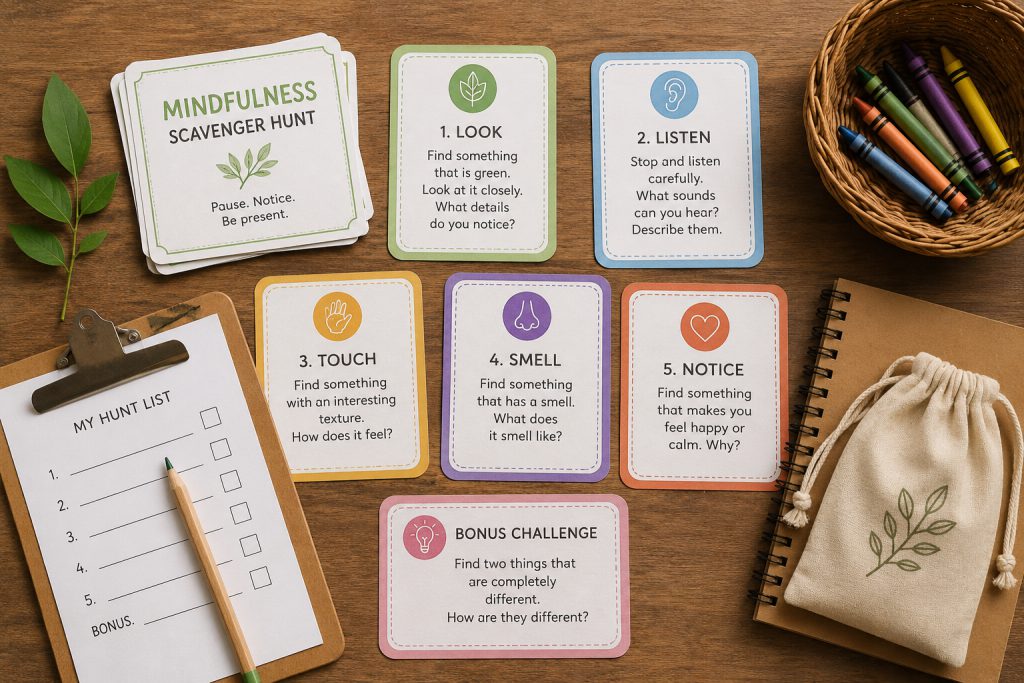
This is the game-changer. Instead of you coming up with prompts on the fly, your kid gets a set of reusable cards with specific, sensory-focused prompts. They feel like they’re on their own quest, and you don’t have to think of what to say.
Print the cards, laminate them if you want them to last, and use them over and over. A compact thermal laminator makes it easy to create durable prompt cards that can be reused year after year. You’ll run this hunt with your kid in spring, then pull the cards out again in July when they’re bored and cranky. The prompts stay fresh because the season and the space have changed.
What’s on Each Card
Each card has one prompt written in kid-friendly language. The prompt names the sense, gives the task, and includes an observation question. For example:
- “Touch something smooth. How does it feel on your skin?”
- “Listen for three sounds. What do you hear?”
- “Find something red. Look very closely. What do you notice?”
The prompt does the thinking for you. No more “Okay, honey, notice something with your eyes.” Just hand them the card and let them go.
How Kids Use the Cards During the Hunt
For younger kids (4–6): You read the card aloud, then explore together. Ask the question on the card, listen to their answer, and move to the next card.
For older kids (7+): They read the card, find the item, explore it, answer the question in their head or aloud, and come back for the next card. No adult direction needed—just presence.
Why Sensory Prompts Work Better Than General Mindfulness
Generic mindfulness language—”Be present,” “Notice your breath,” “Clear your mind”—means nothing to a kid. But “Feel how rough this bark is” or “Listen for bird sounds” gives them something concrete to do. Their brain latches onto the sensory task, and mindfulness happens naturally as a side effect.
This is why a scavenger hunt works when sitting quietly meditating doesn’t. Kids understand what to do.
12 Mindfulness Prompts for Your Scavenger Hunt
Here are the exact prompts your kid will use. Print these, write them on index cards, or simply read them aloud. Adapt them for your space—if you don’t have access to water, swap that prompt for something else available to you.
Want to make the hunt even more exciting? A kids’ magnifying glass set encourages children to slow down and notice tiny details in leaves, bark, flowers, rocks, and insects they might otherwise overlook.
Sight Prompts (What to Look For)
- Color hunt: “Find something that’s your favorite color. Look at it closely. What makes this color special?”
- Light and shadow: “Find a place where light and shadow are playing together. How do the shadows change when you move?”
- Pattern discovery: “Look for something with a pattern—stripes, dots, or repeating shapes. Trace the pattern with your finger. How does it make you feel?”
- Small detail: “Find something small you might usually miss. Really look at it. What do you see that’s interesting?”
Sound Prompts (What to Listen For)
- Sound detective: “Stop and listen for three sounds. Don’t move—just listen. What did you hear?”
- Close and far: “Find a sound that’s close to you. Now listen for a sound far away. Which was easier to hear?”
- Your own sound: “Make a sound with something natural—snap a twig, rustle leaves, tap wood. How does it sound?”
Touch Prompts (What to Feel)
- Texture hunt: “Find something smooth and something rough. Hold them both. How are they different?”
- Temperature: “Find something cool to the touch. Then find something warm. How does each feel on your skin?”
- Gentle touch: “Find something delicate—a flower, a feather, soft moss. Touch it very gently. What does gentle feel like?”
Smell & Taste Prompts (What to Notice)
- Scent discovery: “Find something with a smell—grass, a flower, soil, bark. Smell it slowly. What words describe the smell?”
- No smell: “Find something that doesn’t have a strong smell. How do you know it doesn’t smell?”
Real Benefits: What Mindfulness Scavenger Hunts Actually Do for Kids
Before you print those prompts and head outside, you probably want to know: Does this actually work? The short answer is yes—but not in the way you might expect. A mindfulness scavenger hunt isn’t going to turn your spiraling kid into a zen master in one afternoon. But over time, with repetition, the benefits add up.
Builds Focus and Attention Span
Kids today are overstimulated. Their brains bounce between screens, schedules, and sensations constantly. A mindfulness scavenger hunt does something radical: it asks them to focus on one thing at a time.
When your kid holds a leaf and really looks at the veins, feels the edges, and notices the color, they’re practicing sustained attention. That’s a skill that transfers to homework, conversations, and other everyday tasks that require focus. Research has found that school-based mindfulness practices can improve executive functioning, attention, and behavioral regulation in elementary-aged children. (Flook et al., 2010)
Reduces Anxiety and Overstimulation
Anxious kids live partly in their heads—replaying worries, imagining worst-case scenarios, spiraling in thought loops. A mindfulness scavenger hunt anchors them firmly in the present moment. The sensory tasks—feeling bark, listening for sounds, watching light change—pull their attention out of their worried brain and into their body and the world around them.
This is why mindfulness approaches have been shown to help reduce stress and anxiety in many children. By practicing present-moment awareness, kids can learn to shift their attention away from anxious thoughts and toward what they are experiencing right now. A large systematic review of school-based mindfulness programs found improvements in resilience, cognitive performance, and stress management among children and adolescents. (Zenner, Herrnleben-Kurz & Walach, 2014)

Teaches Self-Awareness
Self-awareness is the foundation of emotional regulation. A mindfulness scavenger hunt teaches kids to notice their own experience. “How does this feel on my skin?” “What emotions does this color bring up?” “How does my body feel when I listen to bird sounds?”
Over time, kids who practice sensory awareness become better at recognizing their own emotional states. They notice when they’re getting overwhelmed before they hit a meltdown. They can identify what they need (calm, movement, touch, quiet).
Makes Mindfulness Feel Fun (Not Forced)
This might be the most important benefit. If your kid associates mindfulness with sitting still in silence, being bored, or feeling like they’re doing it “wrong,” they’ll resist it forever. But if mindfulness feels like exploration, like a game, like their own choice? They might actually ask to do it again.
And that’s when the real learning happens—when kids choose to practice rather than being forced to.
Common Mistakes Parents Make (And How to Fix Them)
Mistake #1: Making Prompts Too Vague
What it sounds like: “Notice something pretty” or “Feel something interesting.”
Why it backfires: Kids don’t know what to focus on. Pretty is subjective. Interesting is too open-ended. Their attention scatters.
The fix: Be specific. “Find a leaf with at least three different colors. Touch it and tell me how it feels.” Now they have a clear target.
Mistake #2: Pushing Mindfulness Language Before Kids Understand It
What it sounds like: “Now let’s practice being present” or “Clear your mind and focus on your breath.”
Why it backfires: Kids don’t understand these concepts. They feel like you’re asking them to do something wrong. They shut down.
The fix: Skip the mindfulness jargon. Just ask sensory questions. “What do you see?” “What does it feel like?” The mindfulness happens without the label.
Mistake #3: Making the Hunt Too Long or Complex for Their Age
What it sounds like: Giving a 5-year-old 15 prompts or asking a 7-year-old to “notice how their body feels when they touch different textures.”
Why it backfires: Kids get overwhelmed, frustrated, or bored. The activity starts to feel like work instead of play. They resist next time.
The fix: Stick to the age recommendations above. Five prompts for younger kids. Shorter, simpler language. Let them move at their own pace. Done in 15 minutes is perfect; dragging it out to 45 minutes is not.
Mistake #4: Setting Unrealistic Expectations
What it sounds like: Thinking one mindfulness scavenger hunt will fix your kid’s anxiety or make them instantly calmer.
Why it backfires: It doesn’t. One hunt won’t change anything. Parents feel disappointed and give up.
The fix: Think of this as one tool in a toolkit, used regularly over time. Benefits build gradually. The magic isn’t in a single hunt—it’s in the practice, repeated.
If you’re looking for even more practical ways to help your child build emotional regulation, resilience, and cooperation, I highly recommend the Positive Parenting Solutions online course. It includes practical, step-by-step strategies for reducing power struggles, improving cooperation, and strengthening your relationship with your child through positive parenting techniques.
Mistake #5: Doing the Same Hunt the Same Way Every Time
What it sounds like: Using the exact same prompts in the exact same space every week.
Why it backfires: Kids get bored. The novelty wears off. They stop engaging.
The fix: Rotate between indoors and outdoors. Change seasons. Shuffle the prompt cards. Try the variations we cover in “Extending the Activity.” Familiar structure, new content, keeps it fresh.
Troubleshooting: What to Do If Your Kid Resists
Your kid might resist. They might say it’s boring, refuse to cooperate, or race through it. This is normal. Here’s what to do:
Resistance: “This is boring. I don’t want to do this.”
Why it happens: The hunt doesn’t feel like play to them yet. Or they’re in a bad mood. Or they didn’t choose to do it.
What to try:
- Drop it. Seriously. No pressure. Try again another day.
- Let them pick the space. “Do you want to hunt in the backyard or the living room?” Choice makes it feel less like a chore.
- Let them create their own prompts. “What should we look for?” gives them ownership.
- Make it competitive. “Can you find five things before I find three?” (Some kids respond to this; others don’t. Know your kid.)
- Connect it to something they care about. “Let’s find things that would make a good fairy house” or “Let’s look for things a dragon might want.”
Resistance: They Rush Through It, Not Really Looking
Why it happens: They just want to finish. The sensory part doesn’t interest them yet, or they’re anxious and speeding through to escape the feeling of being watched.
What to try:
- Set a visual countdown timer for the entire hunt, not individual items. This removes pressure from each prompt. “We have 20 minutes to explore. That’s plenty of time.”
- Do it together. Hold the rock, feel it together. Ask questions while you’re exploring, not as a quiz afterward.
- Remove the “finding” part and just explore one spot. “Let’s sit here and just notice what we see, hear, and feel for five minutes.” Sometimes the hunt structure itself is the pressure.
- Practice one sense at a time. “Today we’re just listening. What do you hear?” Simpler focus, easier to slow down.
Resistance: They Get Overwhelmed or Anxious During the Hunt
Why it happens: The openness of the space, the sensory input, or the pressure to “do it right” becomes too much.
What to try:
- Move indoors or to a smaller, more contained space.
- Reduce the number of prompts from 10 to 4 or 5.
- Do it together the whole time, not with them exploring independently.
- Check in on how their body feels. “Are you okay? Do you need a break?” Anxious kids need to know they can opt out anytime.
- Skip the hunt and just do sensory exploration. No structure, no prompts—just “Let’s feel this moss together.”
Quick Troubleshooting Checklist
Before you give up, go through this:
- ☐ Are your expectations realistic? (Change happens over repeated practice, not in one hunt.)
- ☐ Is this the right time of day? (Hungry, tired, overstimulated kids resist more.)
- ☐ Is the space right? (Too big, too chaotic, or too unfamiliar can overwhelm.)
- ☐ Are the prompts age-appropriate? (Too complex or vague causes confusion.)
- ☐ Is the hunt too long? (10–15 minutes is enough for most kids.)
- ☐ Did you give them any choice or control? (Kids resist less when they have agency.)
- ☐ Are you hovering or putting pressure on them? (Back off. Let them explore naturally.)
- ☐ Have you tried it on a different day? (Bad moods are temporary.)
Extending the Activity: 5 Variations to Keep It Fresh
Once your kid gets the basic hunt down, keep it interesting with variations. These twists use the same core idea but feel new enough to re-engage them:
Variation #1: The “Find and Sketch” Hunt
For kids 7 and up who like to draw: Instead of just exploring items, they sketch what they find. This adds a creative element and gives them something tangible to take home. Even rough sketches work—the point is observation.
Variation #2: The “Four Seasons” Hunt
Do the hunt four times a year in the same space. Spring, summer, fall, winter. Use the same prompts each time, but the discoveries will be totally different. Kids love seeing how the same spot changes across seasons.
Variation #3: The “Treasure Hunt with Rules”
Add constraints: “Find five items, but only things you can hold in your hand” or “Everything must be either green or gray” or “Find things that are rough, smooth, and soft.” Constraints make the hunt more challenging and fun.
Variation #4: The “Scavenger Hunt Walk”
Instead of picking a space and exploring within it, go on a walk and look for items along the way. This works great for kids who need more movement. Every stop is a new space to explore.
Variation #5: The “Nighttime Hunt” (Older Kids Only)
For kids 9 and up: Do a gentle hunt in the early evening or dusk. Everything feels different when the light changes. Sounds become more prominent. It’s quieter. It feels a little magical. (Always supervise and stay in a safe, familiar space.)
Mindfulness Scavenger Hunt in the Classroom
Teachers, this works in your classroom too. A mindfulness scavenger hunt is a portable, no-prep calm-down tool that serves the whole group.
Adapting for Group Settings
The core activity stays the same, but logistics shift slightly:
- Space: Use your classroom, a hallway, an outdoor area, or even window views if you can’t leave the room.
- Group size: Pairs or small groups (3–4 kids) work better than individual hunts. Kids explore together, take turns finding items, help each other notice details.
- Time: 15–20 minutes max, including a 2–3 minute return and settle-down time after.
- Prompts: Use the same card deck you’d use at home. Read them aloud or have kids take turns reading.
- Debrief: End with a 1-minute share: “What did you notice?” This helps kids process and builds class connection.

Timing and Class Size Considerations
A full class of 25 kids doing a scavenger hunt at once is chaos. Instead:
- Run it during transition times: between subjects, after lunch, before dismissal.
- Rotate groups through a smaller space if outdoor access is limited.
- If you have a full class, consider pairing it with a calm-down activity some kids do indoors (journaling, stretching, drawing) while others are on the hunt.
- Expect the first time to be wilder than subsequent times. Kids need to learn how this works.
FAQ: Your Mindfulness Scavenger Hunt Questions Answered
How long should a mindfulness scavenger hunt take?
Most hunts take 15–20 minutes for younger kids (4–7) and 20–30 minutes for older kids (8+). The goal is engagement, not perfection. When energy dips or focus fades, you’re done. Stopping at the right moment (while they still want more) is better than dragging it out.
What age can kids start a mindfulness scavenger hunt?
Ages 4 and up can participate with adult guidance. For ages 4–6, keep it very simple: 5 objects, basic sensory cues, adult reads prompts aloud, lots of hand-holding. Ages 7+ can handle longer hunts with more detailed prompts and more independence.
What if my kid just wants to rush through it?
This is super common. Try setting a timer for the whole hunt (not individual items) to take pressure off. Explore together instead of having them go solo. Do fewer prompts. Or try a different space—sometimes the environment makes a difference. And remember: one fast hunt doesn’t mean it’s not working. Benefits show up over repeated practice.
Can you do this activity with multiple kids at once?
Yes, in pairs or small groups of 3–4. Bigger groups become chaotic. Siblings can hunt together, which is kind of sweet—they notice and discuss things together. In a classroom, rotating small groups works better than a full class at once.
How often should you do a mindfulness scavenger hunt?
Once a week is ideal to build benefits. If that feels like too much, even once every two weeks counts. The consistency matters more than frequency. One hunt a month probably won’t move the needle on anxiety or focus, but weekly practice will.
What’s the difference between mindfulness and meditation for kids?
Meditation is sitting still and focusing inward (on breath, body, or thought). Mindfulness is present-moment awareness of what’s happening around you and within you. A scavenger hunt teaches mindfulness through external focus (noticing the world) rather than meditation’s inward focus. Both teach presence; they just go different directions.
Are mindfulness scavenger hunts good for kids with ADHD?
Yes, with adjustments. Kids with ADHD often respond better to movement-based activities than sitting still. A hunt that gets them moving while practicing focus works well. Keep individual prompts short, use a timer so they know how long it’ll take, let them move at their own pace, and celebrate effort rather than “perfect” exploration. For kids with severe attention challenges, explore just one sense at a time: a five-minute listening hunt, or a five-minute texture hunt. Simpler focus.
Can a teacher use this in a classroom setting?
Definitely. See the “Mindfulness Scavenger Hunt in the Classroom” section above. It’s a low-prep, portable tool that works during transitions, after lunch, or as a class reset. Teachers love it because it’s calming, uses minimal materials, and addresses SEL standards at the same time.
Do you need to buy special materials or supplies?
No. Zero cost is required. You can print the prompt cards, write them by hand, or memorize them and read them aloud. You don’t need a timer, clipboard, or collection bag—though these are nice-to-haves. The activity works with nothing but a space and your presence.
Are there virtual or screen-based mindfulness scavenger hunts?
There are online activities branded as “mindfulness hunts,” but they miss the whole point: the sensory, embodied experience. A screen-based version isn’t a true mindfulness scavenger hunt. Save this activity for real-world, real-sensory exploration. If your kid can’t be outdoors, an indoor hunt works just as well.
Key Takeaways
- A mindfulness scavenger hunt combines the fun of exploration with one of the easiest mindfulness activities for kids, making mindfulness feel like play instead of meditation.
- Age-appropriate setup matters. Younger kids need simpler prompts and adult guidance; older kids can handle more complexity and independence.
- Sensory-specific prompts (“Find something soft”) work better than vague ones (“Notice something interesting”). They give kids a clear focus.
- Benefits build over repeated practice. One hunt won’t change everything, but weekly hunts over months will improve focus, reduce anxiety, and build self-awareness.
- Resistance is normal. When kids push back, simplify, give them more control, or try a different day. The hunt isn’t “failing”—you’re just adjusting the approach.
- This activity works indoors and outdoors, at home and in the classroom, for anxious kids and ADHD kids and kids who just need to slow down.
- You need almost no supplies. A few prompt cards and a quiet space is enough.
Conclusion: Start Simple, Let It Grow
You don’t need to be a mindfulness expert to run a mindfulness scavenger hunt. You just need a space, some prompts, and permission to let your kid slow down and notice things.
Start simple. Print the prompt cards or write them on index cards. Pick a space you can access easily (your backyard, a park, your living room). Tell your kid: “We’re going to hunt for things and really pay attention to how they feel, sound, look, and smell.” Do the first hunt, see what happens, and adjust from there.
Don’t expect magic in one afternoon. Expect to see small shifts over weeks: your kid pausing a little longer before responding, noticing details they’d normally miss, breathing a little easier during stressful moments.
And expect that one day, your anxious kid will ask, “Can we do another mindfulness hunt?” That’s when you’ll know it’s working.
Related reading: Emotional Regulation Activities for Kids • Sensory Activities for Kids • Activities for Teaching Emotional Regulation Skills