

Limits vs. Consequences: The Real Difference (and How to Use Both)
Quick Answer: A limit is the boundary you set before or during a behavior to stop it in the moment, like blocking a hit with your hand. A consequence is what happens after the behavior, either naturally or because you step in, to reinforce the lesson the limit alone can’t teach.
You’ve said “there will be consequences” so many times it doesn’t even make your kid look up anymore.
Here’s the thing: a limit and a consequence aren’t the same tool, even though most of us use the words like they are. A limit is what stops the behavior right now. A consequence is what happens after, so the lesson actually sticks. Mix them up, and you end up with vague threats instead of real teaching.
This matters because kids who grow up with clear, consistent limits and connected consequences tend to develop stronger self-control and take more ownership of their choices (Source: American Academy of Pediatrics). Kids raised on empty threats mostly just learn to wait you out.
By the end of this, you’ll know exactly which tool to reach for in the moment, how to follow through without turning into the bad guy, and what to say instead of “or else.”
Heads up: This post may include affiliate links. As an Amazon Associate, I earn from qualifying purchases—at no extra cost to you. Full privacy policy and disclosure here.
What’s the Real Difference Between a Limit and a Consequence?
The whole distinction comes down to one thing: timing.
A limit is the boundary you set before or during a behavior, to stop it from happening or continuing. A consequence is what happens after the behavior, to reinforce what the limit already said.
Think of it this way: the limit is the fence. The consequence is what happens if your kid climbs over it anyway. You need both. A fence with no follow-through gets climbed constantly. Consequences with no fence to begin with just feel like random punishment.
| Limit | Consequence |
|---|---|
| Set before or during the behavior | Happens after the behavior |
| Stops the action in the moment | Reinforces the lesson over time |
| Stated once, calmly, and held firm | Delivered without anger, connected to what happened |
| Example: “We don’t hit. Hands are for helping.” | Example: “Since you hit, playtime with your brother is done for now.” |
Is This a Limit or a Consequence? Quick-Check
Not sure which tool you actually need in the moment? Run through these:
- Is the behavior happening right now, in front of you? → That’s a job for a limit.
- Has the behavior already happened, and you’re deciding what comes next? → That’s a job for a consequence.
- Are you trying to stop something, or teach something? Stopping = limit. Teaching = consequence.
- Could you say this calmly in one sentence, without a threat attached? If not, pause before you say it.
- Is what you’re about to say connected to the actual behavior, or is it random? Random isn’t a consequence — it’s a punishment.
Limits vs. Consequences vs. Punishment: Where They Overlap (and Where They Don’t)
This is where most of the confusion lives. A lot of parents assume a consequence has to sting to work. It doesn’t. The most effective consequences are connected, not painful.
Natural Consequences
A natural consequence happens on its own, with no action from you. Your child leaves a toy outside, it rains overnight, and the toy is ruined. Nobody had to lecture. Reality did the teaching.
Natural consequences are powerful because kids trust them — you didn’t make it happen, life did. But they only work when they’re safe. Never let a natural consequence play out if it puts your child’s health or safety at risk (Source: American Academy of Pediatrics). A toddler who won’t hold your hand near a parking lot doesn’t get to “learn the natural way.”
Logical Consequences
A logical consequence is connected to the behavior, but it requires you to step in and make it happen. Your child draws on the wall, so they help clean it up. Your teen misses curfew, so the next outing starts earlier. The link between the action and the result has to make sense to your kid, or it won’t land as a lesson.
If you’re looking for language that keeps you calm while you set these limits, the How to Talk So Kids Will Listen approach is one of the most useful frameworks parents turn to for exactly this. How to Talk So Kids Will Listen
Punishment (and Why It’s Different)
Punishment is a penalty handed down that isn’t necessarily connected to the behavior, and its main goal is to make a child feel bad enough that they stop. Taking away a bike for a week because your child talked back at dinner is punishment — there’s no logical link between the two.
Punishment can suppress behavior short-term, but it tends to teach kids to avoid getting caught rather than to understand why something was wrong. Logical and natural consequences, on the other hand, help kids connect cause and effect, which supports long-term self-regulation (Source: American Academy of Pediatrics). If you want a deeper toolbox for staying calm while you enforce limits instead of slipping into punishment mode, this no-yelling parenting toolbox is worth bookmarking.
| Type | Who Causes It | Connected to Behavior? | Example |
|---|---|---|---|
| Natural | Happens on its own | Yes, directly | Forgets coat, feels cold |
| Logical | Parent sets it up | Yes, related | Draws on wall, helps clean it |
| Punitive | Parent imposes it | No, often random | Talks back, loses bike for a week |
Same Moment, Two Paths: 3 Real Examples
The difference between a limit and a consequence gets a lot clearer when you see them applied to the exact same moment. Here’s what that looks like for three flashpoints almost every parent recognizes.
Hitting a Sibling
The limit (in the moment): Step between them, block the hit with your hand or body, and say calmly, “I won’t let you hit your brother. Hands are for helping, not hurting.”
The consequence (after): “Since you hit your brother, you two need some space from each other right now. You can try playing together again after everyone’s calm.”
Sibling conflict is one of those things that never fully disappears, but it does get more manageable with the right tools. handling sibling jealousy and joint sibling projects are both great next reads if this is a daily flashpoint in your house.
Refusing to Leave the Playground
The limit (in the moment): Get down to their level and say, “We’re leaving now. You can walk to the car, or I’ll carry you — your choice.” Then follow through.
The consequence (after): “Leaving the playground was really hard today. Next time we come, we’ll need to practice leaving calmly before we can stay as long.”
Ignoring Bedtime
The limit (in the moment): “It’s bedtime now. You can pick the last book, but then it’s lights out.” State it once, and don’t get pulled into negotiating a tenth time.
The consequence (after): “Since bedtime took a lot longer tonight, tomorrow’s bedtime routine starts earlier so we have time to do it calmly.”
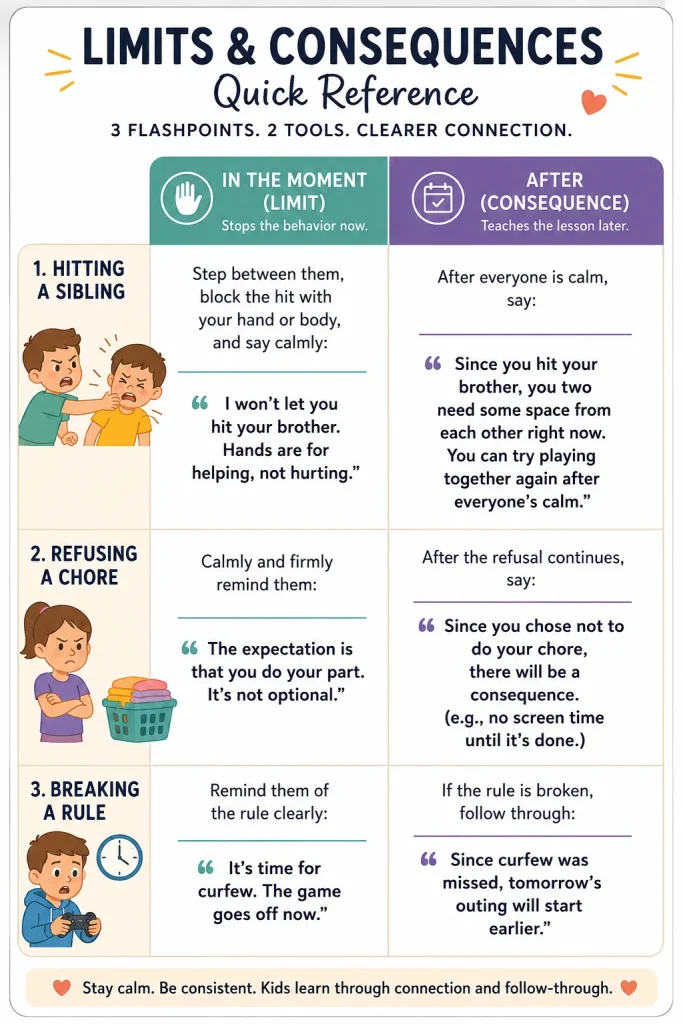
Grab the printable version of these three scripts so you’ve got the exact wording ready before the next meltdown hits — no scrambling for the right words mid-tantrum.
How to Set a Limit That Actually Holds
A limit only works if it’s delivered in a way your child can actually follow. Here’s the sequence that holds up best in the moment.
- State it once, calmly: Say the limit in one short sentence, in a normal tone. Repeating it five times with rising volume teaches your child that the real limit doesn’t kick in until warning number five.
- Offer a choice within the limit: “You can walk or I’ll carry you” gives your child some control without changing the boundary itself.
- Get down to their level: Physical presence and eye contact communicate that you mean it far more than volume does.
- Follow through immediately: If they don’t comply, act — carry them, remove the item, block the behavior. Don’t just keep talking.
- Skip the lecture: Save the explanation for later, when everyone’s calm. In the heat of the moment, kids can’t absorb a paragraph.
If backtalk tends to show up the second you set a limit, this guide to handling backtalk pairs well with the steps above. And if you notice your child needs something physical to do with their hands while they settle down, a simple sensory tool can help bridge the gap. this fidget toy set gives restless hands something to do while the limit sinks in, and a chew necklace can help younger kids self-regulate through a hard moment.
How to Follow Through on a Consequence Without Becoming the Bad Guy
Consequences land differently depending on how they’re delivered. Here’s how to keep them from turning into punishment.
- Deliver it without anger: A flat, calm tone communicates “this is just how it works,” not “I’m furious at you.”
- Keep it connected: If the consequence doesn’t logically relate to the behavior, your child won’t make the connection — they’ll just feel punished.
- Keep it small enough to actually enforce: A consequence you can’t follow through on every time teaches your child that limits are optional.
- Skip the “I told you so”: Once the consequence is delivered, let it do the teaching. Piling on commentary turns it back into a lecture.
- Reconnect afterward: A quick hug or a few kind words once things are calm reminds your child the relationship is still solid.
Follow-Through Readiness Checklist
Before you deliver a consequence, run through this:
- Is it connected to what actually happened?
- Can I follow through on this every single time, not just when I have the energy?
- Am I delivering this calmly, without anger or sarcasm?
- Is this realistic for my child’s age and understanding?
- Will I be able to reconnect warmly once it’s done?
Genuine words of encouragement go a long way once the consequence has played out. words of affirmation for kids is a great next stop if you want language for reconnecting after a hard moment.
Limits and Consequences by Age
The framework stays the same, but what it looks like shifts a lot as your child grows.
Toddlers (1–3)
At this age, limits do almost all of the work. Toddlers can’t yet connect a delayed consequence to something they did an hour ago, so the limit — physically stopping the behavior, calmly and consistently — is the main tool. Keep language to a handful of words.
Preschoolers (3–5)
Preschoolers can start to understand simple, immediate logical consequences (“Since you threw the toy, it goes on the shelf for now”). Keep the gap between behavior and consequence short — same day, ideally within the hour.
School-Age Kids (6–10)
Kids this age can handle consequences that wait a bit longer and involve more reasoning (“Since homework wasn’t finished, screen time waits until it is”). This is also a good age to start involving them in choosing consequences together.
Tweens and Teens (11+)
Limits shift from physical boundaries to agreed-upon rules and privileges. Consequences work best when they’re discussed in advance and tied to trust and responsibility, like curfews or phone privileges, rather than one-off punishments.
| Age | Primary Tool | What It Looks Like |
|---|---|---|
| Toddlers | Limits | Physically stop the behavior, few words, repeat calmly |
| Preschoolers | Limits + immediate consequences | Simple, same-day logical consequences |
| School-age | Balanced | Consequences can wait longer, more reasoning involved |
| Tweens/teens | Agreed-upon consequences | Discussed in advance, tied to trust and privileges |
Common Mistakes That Blur the Line
A few habits tend to sneak in and turn a good system into a confusing one.
- Using “consequence” as a vague threat. “There will be consequences” doesn’t teach anything because it’s not specific. Name the actual consequence, or don’t say it yet.
- Choosing a consequence unrelated to the behavior. Taking away dessert for hitting doesn’t connect. Your child just feels punished, not taught.
- Over-explaining a limit in the heat of the moment. Long reasoning during a meltdown usually invites more pushback, not less.
- Threatening a consequence you won’t enforce. Every empty threat makes the next real limit harder to hold.
- Letting an unsafe natural consequence play out. Safety always overrides “let them learn the hard way.”
- Delivering consequences with anger or shame. That turns a consequence back into a punishment, even if the wording sounds fine.
- Inconsistent enforcement between caregivers. If one parent holds the limit and the other doesn’t, kids learn to wait for the easier adult.
Power struggles are usually where all of these mistakes show up at once. this guide to diffusing power struggles is a solid next read if this section felt a little too familiar.
Frequently Asked Questions
Is a consequence the same as a punishment?
No. A consequence is connected to the behavior and teaches a lesson, while a punishment is often unrelated and meant to make a child feel bad rather than understand cause and effect.
What is a limit in parenting?
A limit is the boundary you set before or during a behavior to stop it in the moment, like physically blocking a hit or stating a firm rule while it’s happening.
What is a consequence in parenting?
A consequence is what happens after a behavior, either naturally or because a parent steps in, to reinforce the lesson the limit already set.
Should I give a warning before a consequence?
One clear warning is usually enough. Repeated warnings teach kids that the limit isn’t real until you’ve said it several times.
What’s a natural consequence example?
A child who refuses to wear a coat gets cold outside — no action from the parent is required for the lesson to happen.
What’s a logical consequence example?
A child who draws on the wall helps clean it up. The consequence is connected to the behavior, but it requires the parent to set it up.
Do limits and consequences work for toddlers?
Yes, but limits do most of the work at this age, since toddlers usually can’t yet connect a delayed consequence back to their original action.
What if my child doesn’t care about the consequence?
It’s likely not connected enough to the behavior. Swap it for something more logically tied to what actually happened, rather than making it harsher.
Can a consequence be positive?
Yes. Natural positive consequences, like earning more independence after consistently following through, reinforce good choices just as effectively.
How do I stay consistent when I’m too tired to follow through?
Choose consequences small enough that you can realistically enforce them every single time. Consistency matters far more than severity.
You’ve Got This More Than You Think
Limits and consequences aren’t about being the strict parent or the fun parent. They’re two different tools that work together — one stops the moment, the other teaches the lesson.
You won’t get it perfect every time, and that’s fine. What matters is that you’re clear, you follow through, and you reconnect afterward. That’s what actually sticks.
Try picking just one of the “Same Moment, Two Paths” scripts above and using it this week. Small, consistent language changes add up faster than you’d expect.
You might also love:

