
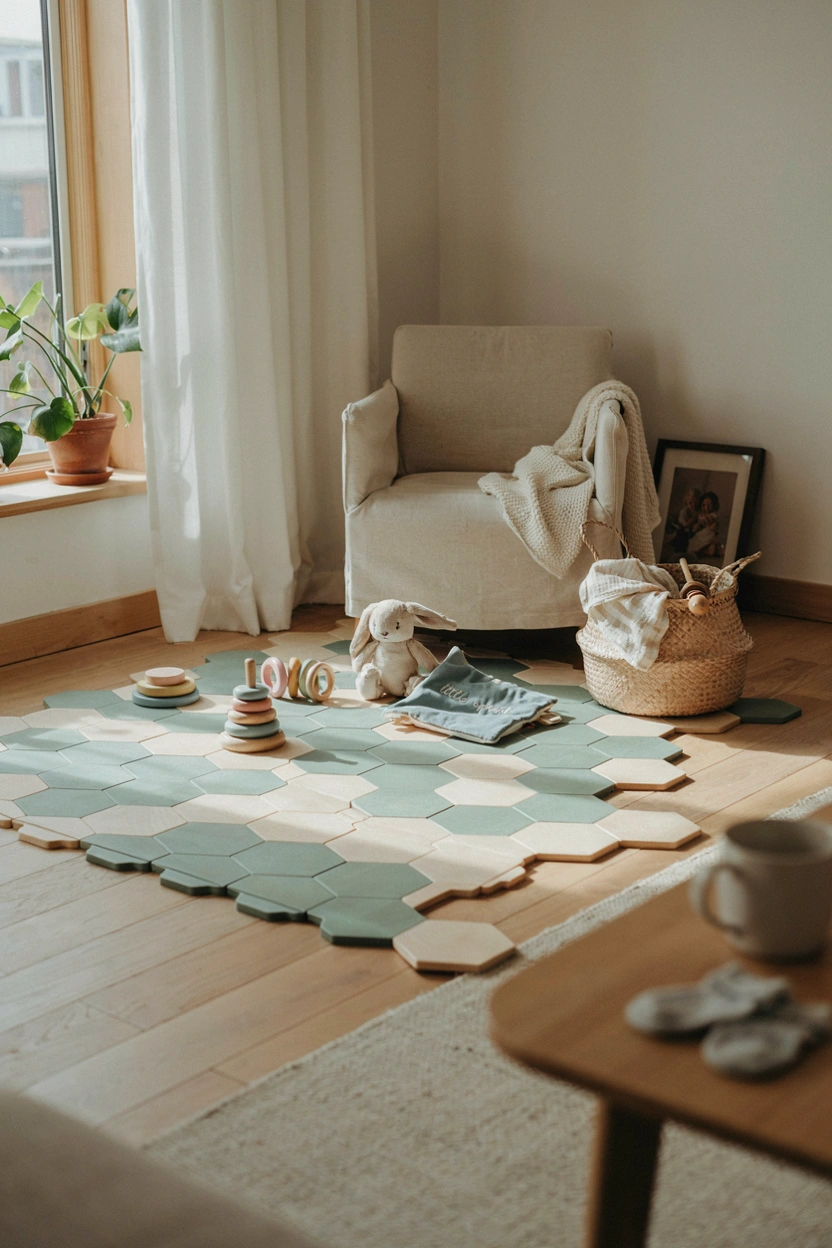
10 DIY Baby Play Area Ideas to Create a Safe and Fun Space at Home
Quick Answer: A DIY baby play area at home needs four basics: soft, padded flooring, a baby-proofed boundary, a small rotation of age-appropriate toys, and a comfortable spot for you to sit nearby. Pick a corner you can supervise easily, lay down foam mats or a thick rug, gate off the space, and add two or three toys at a time. That’s it — no playroom required.
You don’t need a Pinterest-perfect nursery to give your baby a great place to play. Most of the time, all it takes is a corner of your living room and a plan.
A DIY baby play area at home is exactly what it sounds like: a small, dedicated spot where your baby can crawl, reach, and explore without you hovering over every move. It’s built from things you likely already own or can grab cheaply, and it takes an afternoon, not a renovation.
Why does this matter? Babies learn almost everything about the world through movement and touch in those first year or two. A space that’s actually set up for that kind of exploring gives them more chances to practice new skills, and it gives you a few minutes to sit down without constantly saying “no, not that.”
By the end of this article, you’ll know exactly what to put in your baby’s play area, how to set it up step by step, and how to keep it safe and interesting as your baby grows.
Heads up: This post may include affiliate links. As an Amazon Associate, I earn from qualifying purchases—at no extra cost to you. Full privacy policy and disclosure here.
Why Bother Setting Up a Dedicated Play Area?
It’s tempting to just let the baby play wherever, with whatever’s nearby. That works for a while, but a dedicated spot actually does a few things at once.
- It encourages independent play. Babies get used to entertaining themselves for short stretches, which buys you time to fold laundry or drink a coffee while it’s still hot.
- It builds motor skills safely. Rolling, reaching, pulling up, and eventually cruising along furniture all happen more freely when the floor is soft and the space is clear.
- It cuts down on hazards. A contained, baby-proofed area means fewer moments of grabbing something out of tiny hands mid-crawl.
- It supports sensory development. Different textures, sounds, and things to look at all feed into early learning (Source: American Academy of Pediatrics).
None of this requires a spare room. A well-thought-out corner does the job just fine.
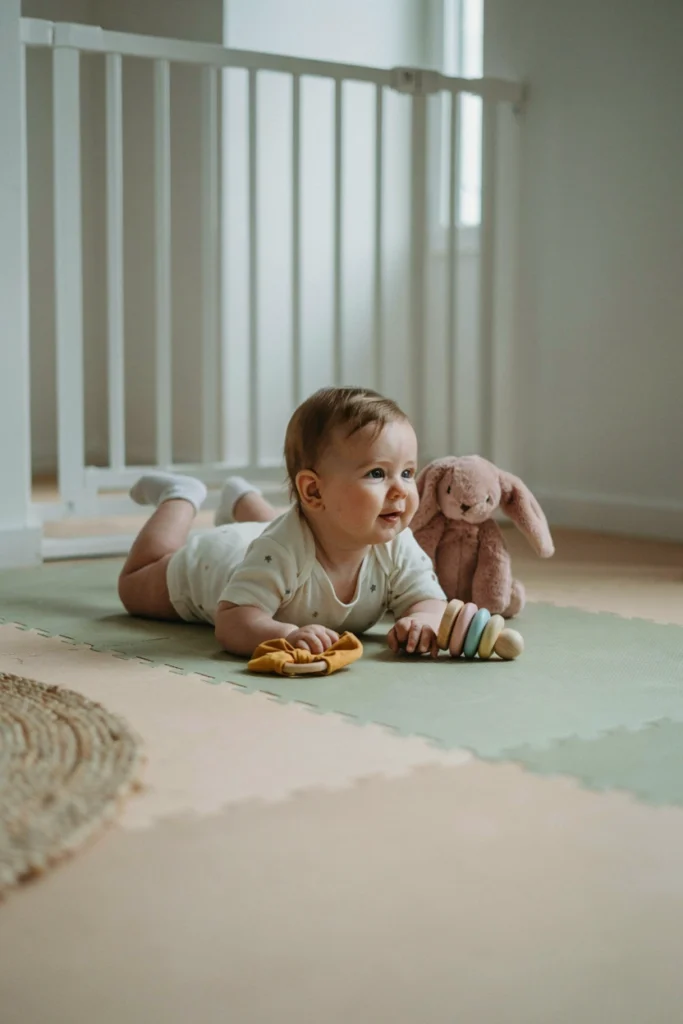
What You Actually Need for a DIY Baby Play Area at Home
Before you rearrange furniture, it helps to know what the space actually needs. It comes down to four things: flooring, boundaries, toys, and somewhere for you to sit.
1. Soft, Padded Flooring
Crawlers and new walkers fall a lot. That’s normal, but a cushioned surface makes it a lot less dramatic. Good options include:
- Interlocking foam floor tiles — 36 tiles is usually enough to cover a full corner, and they wipe clean fast.
- A thick memory foam play mat — good if you want one solid piece instead of interlocking tiles.
- A soft, machine-washable area rug — an easy layer over existing carpet in a shared living space.
- A foldable gym mat — folds flat for storage, which helps if the play area needs to disappear sometimes.
Whatever you choose, make sure it’s non-toxic, easy to wipe down, and thick enough to actually cushion a bump, not just look soft.
2. Baby-Proofed Boundaries
You want a space your baby can explore without you needing to say “come back here” every thirty seconds. A few ways to do that:
- A playpen or freestanding gate — this large 78″x78″ playpen works indoors or out and gives a genuinely roomy space to move in.
- Low shelving used as a natural divider — a low cube storage shelf marks the boundary and doubles as toy storage.
- A room divider or repurposed bookshelf
Containing the space isn’t about restricting your baby — it’s about giving them room to move without you needing to watch every single second.
3. Age-Appropriate Toys
Rotate a small selection every week or two instead of dumping the whole toy bin in one spot. A few reliable picks:
- Soft stacking blocks with letters, animals, and textures give more than one skill to practice at once.
- A musical caterpillar plush is an easy favorite for tummy time.
- Stacking rings
- Baby-safe mirrors
- Textured sensory balls
Less really is more here. A cluttered play area tends to overwhelm babies rather than engage them, so two or three toys at a time usually works better than ten.
4. A Comfortable Spot for You
Don’t forget yourself in this setup. A floor cushion or a small chair nearby means you can actually supervise comfortably instead of hovering awkwardly on your knees the whole time.
How to Set Up Your DIY Baby Play Area, Step by Step
Once you know what you need, setting it up is mostly a matter of order. Here’s how to go about it.
- Choose the right location: Look for a spot you can supervise easily, with natural light and minimal distractions — a corner away from the TV usually works best. A living room corner, a wide hallway, or part of the nursery are all common choices.
- Baby-proof the space: Cover outlets, anchor any heavy furniture nearby, remove choking hazards, and tuck cords and blind pulls out of reach. This is the real foundation of a safe DIY baby play area at home (Source: American Academy of Pediatrics).
- Lay down safe flooring: Add your padded mats or rug as a base layer, and make sure the edges are secured so nothing curls up and becomes a tripping hazard.
- Set up zones: Even a small space can have a soft toy zone, a movement zone with room to crawl or a mini tunnel, and a sensory zone with different textures or a mirror.
- Add developmental toys: Stick to simple, open-ended toys that invite curiosity rather than ones that do all the entertaining themselves. Rotate every week or so to keep things interesting.
If you’re also getting ready for outings, [[INTERNAL LINK: Diaper bag essentials checklist for newborns | this diaper bag essentials checklist]] is worth a look too.
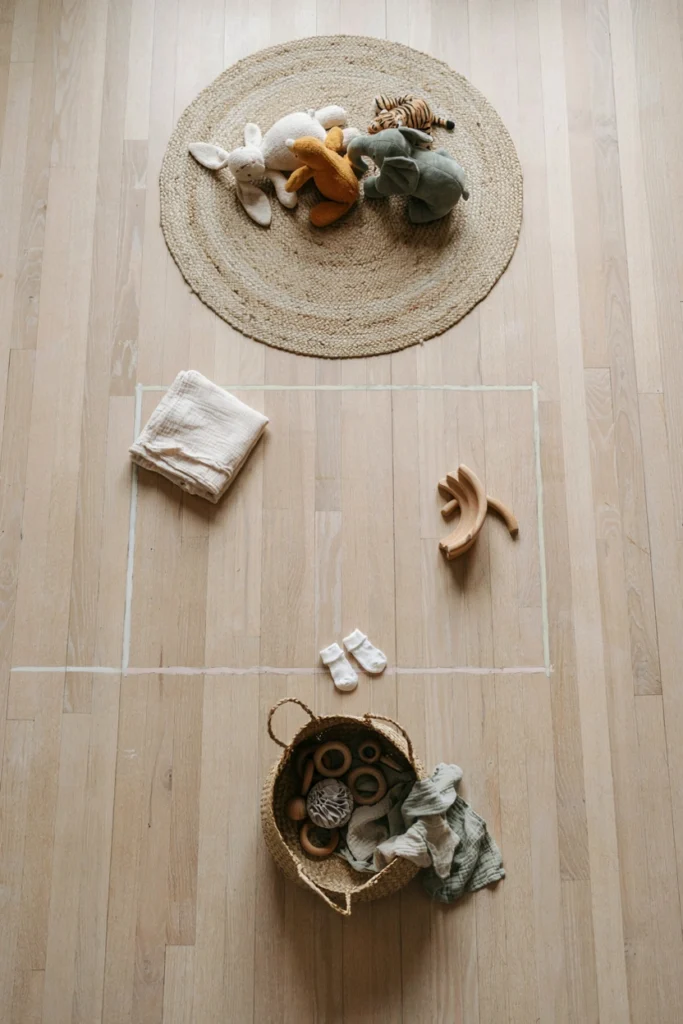
Keeping the Play Area Safe as Your Baby Grows
A play area that’s safe on day one doesn’t stay that way automatically. A few habits keep it that way:
- Check toys regularly for loose parts or small pieces that could come off.
- Clean mats and toys weekly, more often if your baby mouths everything (most babies do).
- Keep heavy shelves or unstable furniture out of the play zone entirely.
- Never leave your baby unsupervised for long stretches, even in a gated space.
The goal is freedom within boundaries — a space where your baby can explore and you can actually relax a little, instead of white-knuckling every move.
Making the Play Area More Stimulating
Once the basics are covered, small additions can make the space feel a lot more engaging without adding clutter.
Sensory Baskets
Fill a small basket with a mix of textures — crinkly paper, a silicone kitchen tool, a scrap of soft fabric — and let your baby dig through it. This is one of the cheapest upgrades you can make, since most of it is already sitting in a kitchen drawer.
Visual Interest
Hang colorful art prints, a baby-safe mirror, or black-and-white pattern cards at your baby’s eye level, not yours. Newborns and young infants especially respond to high-contrast patterns (Source: American Academy of Pediatrics), which is exactly what this black-and-white crinkle book and mirror toy is built for.
Movement Opportunities
Low, sturdy furniture gives babies something safe to pull up on. Cushioned obstacles, like a small foam tunnel or soft steps, encourage crawling practice without the risk of a hard fall.
Play with Light
Soft string lights kept well out of reach, or a baby-safe light projector, can turn early evening play into something your baby actually looks forward to.
Building on This Setup as Your Child Grows
A play area isn’t a one-time project — it evolves as your baby does. Once the basics are in place, you can layer in more targeted activities. For newborns, [[INTERNAL LINK: Fun and simple newborn play ideas | these newborn play ideas]] pair well with the sensory zone you’ve already built. As your child moves into toddlerhood, [[INTERNAL LINK: Water table activities for toddlers | water table activities]] and [[INTERNAL LINK: Summer sensory activities for toddlers | sensory activities]] keep the same space useful for longer.
You can also rotate in [[INTERNAL LINK: Imagination games for toddlers | imagination games]] and [[INTERNAL LINK: Problem-solving activities for toddlers | problem-solving activities]] as attention spans grow, and keep a running list of [[INTERNAL LINK: Indoor activities for kids | indoor activity ideas]] on hand for the days you need something new in five minutes flat.
Frequently Asked Questions
At what age should I set up a DIY baby play area?
You can start as early as 3 to 4 months old. Early setups usually center on tummy time mats and simple visual stimulation, then shift toward crawling zones around 6 to 9 months as mobility increases.
How big does a baby play area need to be?
There’s no set minimum. A space around 5 by 5 feet works fine for newborns and young infants. Once your baby starts crawling and cruising, a larger area with more open floor gives them room to actually use those new skills.
What’s the best flooring for a baby play area?
Non-toxic foam mats are the most practical choice for most families — they cushion falls, wipe clean easily, and hold up over time. A thick area rug layered over carpet is a solid low-budget alternative.
How do I keep the play area from turning into a toy explosion?
Store the rest of the toys in low bins, baskets, or a small shelf, and only pull out two or three at a time. Rotating toys this way keeps babies from getting overstimulated and makes cleanup a lot faster.
Does the play area need to be in its own separate room?
Not at all. Most families tuck the play area into a corner of the living room or another shared space. A distinct mat color, a baby gate, or simple furniture placement is enough to mark it as its own zone without needing a dedicated room.
Key Takeaways
- A baby play area needs just four things: soft flooring, a boundary, a small toy rotation, and a spot for you to sit.
- Baby-proofing the space is the actual foundation — flooring and toys come after that step, not before it.
- Two or three toys at a time, rotated weekly, keeps a baby more engaged than a full toy bin dumped on the floor.
- The setup should grow with your baby, shifting from tummy time basics to crawling zones to toddler-friendly activities.
- A separate room is never required — a well-marked corner of a shared space works just as well.
A Play Area That Actually Works for Your Home
A DIY baby play area at home doesn’t need to look like a magazine spread to do its job. What matters is that it’s safe, it’s set up for your baby’s current stage, and it gives both of you a little breathing room.
You already have most of what you need to make this work — a corner, a mat, a few good toys, and a bit of patience while your baby figures it out.
Pick one corner today, lay down something soft, and add two toys to start. You can build from there.


