

Safe Sunscreen for Kids: The Complete Guide to Protecting Your Child at Every Age
Quick Answer: Safe sunscreen for kids uses mineral active ingredients — zinc oxide or titanium dioxide — instead of chemical ones like oxybenzone. Choose SPF 30 or higher, broad-spectrum, and water-resistant. Apply generously 15 minutes before sun exposure and reapply every two hours, or immediately after swimming or sweating.
You’ve stood in that sunscreen aisle. You’re holding two bottles, squinting at the back labels, wondering what half these ingredients are — and whether you’re choosing protection or accidentally slathering something questionable on your kid’s skin.
The honest truth is that sunscreen safety has gotten more complicated in recent years. The FDA updated its sunscreen regulations, ingredient concerns have made headlines, and the options on shelves have multiplied. Parents deserve clear answers — not more confusion.
Sun protection matters enormously for kids. Just a few serious sunburns in childhood can significantly raise a person’s lifetime risk of skin cancer. According to the American Academy of Dermatology, protecting children’s skin from UV damage is one of the best ways to reduce future skin cancer risk. That’s not meant to scare you — it’s meant to make this feel worth figuring out.
By the end of this guide, you’ll know exactly which ingredients are safe and which to skip, how to choose the right sunscreen for your child’s age and skin type, and how to apply it in a way that actually works. No more label paralysis at the store.
Heads up: This post may include affiliate links. As an Amazon Associate, I earn from qualifying purchases—at no extra cost to you. Full privacy policy and disclosure here.
Why Sunscreen Safety Matters More for Kids Than Adults
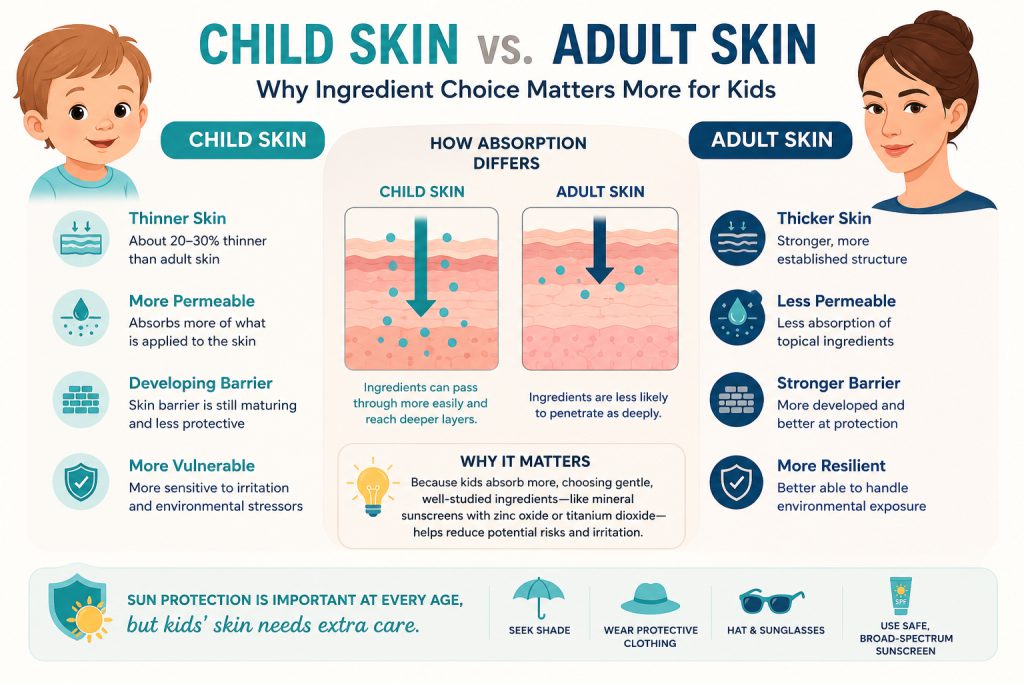
Children’s skin is genuinely different from adult skin. It’s thinner, more permeable, and absorbs topical substances more readily. That means what goes on their skin matters in ways it doesn’t for adults.
The American Academy of Pediatrics (AAP) recommends that parents prioritize mineral-based sunscreens for infants and young children because they are less likely to irritate sensitive skin and provide broad-spectrum protection. Young skin is still developing its natural barrier function, which makes the ingredient list on your sunscreen more important — not less.
There’s also the cumulative sun exposure angle. The Skin Cancer Foundation notes that childhood and adolescent sun exposure plays a major role in lifetime skin cancer risk. Starting sun protection habits early — and doing it correctly — makes a real difference over a lifetime.
Chemical vs. Mineral Sunscreen: What’s the Real Difference?
This is the question most parents are actually asking when they reach for the label. And it’s a good one.
How Chemical Sunscreen Works — and Why It Concerns Some Parents
Chemical sunscreen works by absorbing UV rays and converting them into heat, which the skin then releases. The active ingredients — things like oxybenzone, octinoxate, avobenzone, and octisalate — are absorbed into the skin to do their job.
The concern with certain chemical active ingredients, particularly oxybenzone, is that they’re absorbed into the bloodstream at measurable levels. The U.S. Food and Drug Administration (FDA) proposed in 2019 that oxybenzone and octinoxate require additional safety data before they can be classified as Generally Recognized as Safe and Effective (GRASE). That isn’t the same as saying they’re proven harmful — but it’s one reason many parents choose mineral sunscreen for young children when it’s available.
How Mineral Sunscreen Works — and Why Dermatologists Often Prefer It for Kids
Mineral sunscreen (sometimes called physical sunscreen) works differently. Instead of being absorbed, zinc oxide and titanium dioxide sit on top of the skin and physically reflect UV rays away — like a mirror. They’re not absorbed into the bloodstream in meaningful amounts.
Both zinc oxide and titanium dioxide are classified by the U.S. Food and Drug Administration (FDA) as Generally Recognized as Safe and Effective (GRASE) sunscreen ingredients. Pediatric dermatologists and the American Academy of Pediatrics (AAP) also recommend mineral sunscreens as the preferred choice for babies and young children because they’re gentle on sensitive skin and provide broad-spectrum protection.
Which Is Actually Safer for Children?
For kids — especially babies and toddlers — mineral sunscreen with zinc oxide or titanium dioxide is the stronger choice. It sits on top of the skin rather than being absorbed, it’s effective immediately upon application, and both active ingredients have a long, well-documented safety record.
That doesn’t mean every chemical sunscreen is dangerous. For older kids and teens, some chemical formulas with safer actives like avobenzone or octisalate are widely used. But if you want the least complicated answer: reach for mineral first.
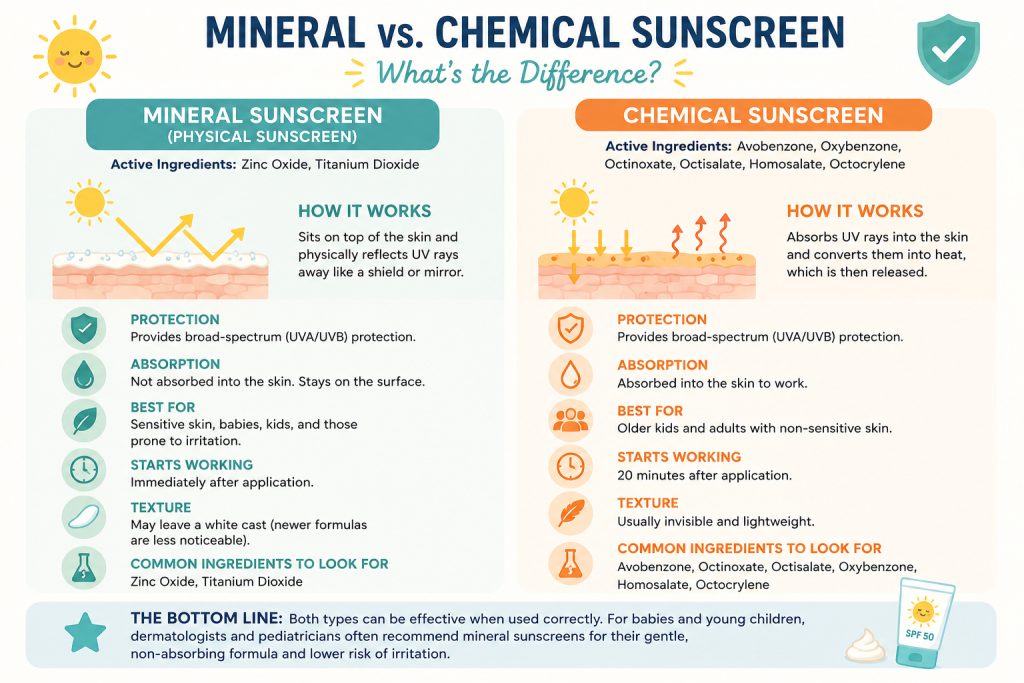
| Feature | Mineral Sunscreen | Chemical Sunscreen |
|---|---|---|
| Active Ingredients | Zinc oxide, titanium dioxide | Oxybenzone, octinoxate, avobenzone, octisalate, others |
| How It Works | Sits on skin, reflects UV rays | Absorbs into skin, converts UV to heat |
| Skin Absorption | Minimal | Measurable bloodstream absorption |
| FDA Status | GRASE (safe and effective) | Mixed — some actives need more data |
| Works Immediately? | Yes | Needs 15–30 minutes to activate |
| Texture | Thicker, may leave white cast | Lighter, absorbs easily |
| Best For | Babies, toddlers, sensitive skin, all ages | Older kids, teens, active use |
Safe Sunscreen Ingredients to Look For
Learning to read a sunscreen label is a skill worth having. The key is knowing which “active ingredients” are doing the protection work — and whether those are the ones you want.
The FDA-Approved Active Ingredients Safe for Kids
There are only two active ingredients the FDA currently classifies as both safe and effective for sunscreen. Both are mineral:
- Zinc oxide — The gold standard for kids. Provides broad-spectrum UVA and UVB protection, is gentle on sensitive skin, and is recognized by the U.S. Food and Drug Administration (FDA) as a Generally Recognized as Safe and Effective (GRASE) sunscreen ingredient.
- Titanium dioxide — Also mineral and broadly safe, though it provides slightly stronger UVB protection than UVA compared to zinc oxide. Often paired with zinc oxide for complete coverage.
Both can be used on babies over six months and are recommended for children with sensitive skin or eczema.
What About Other Approved Chemical Actives?
Not all chemical actives are equally concerning. Avobenzone and octisalate are among the chemical actives with better safety profiles — they’re widely used and haven’t raised the same red flags as oxybenzone. If you’re using a chemical sunscreen for an older child or teen, look for these over oxybenzone.
Pre-Shopping Sunscreen Checklist:
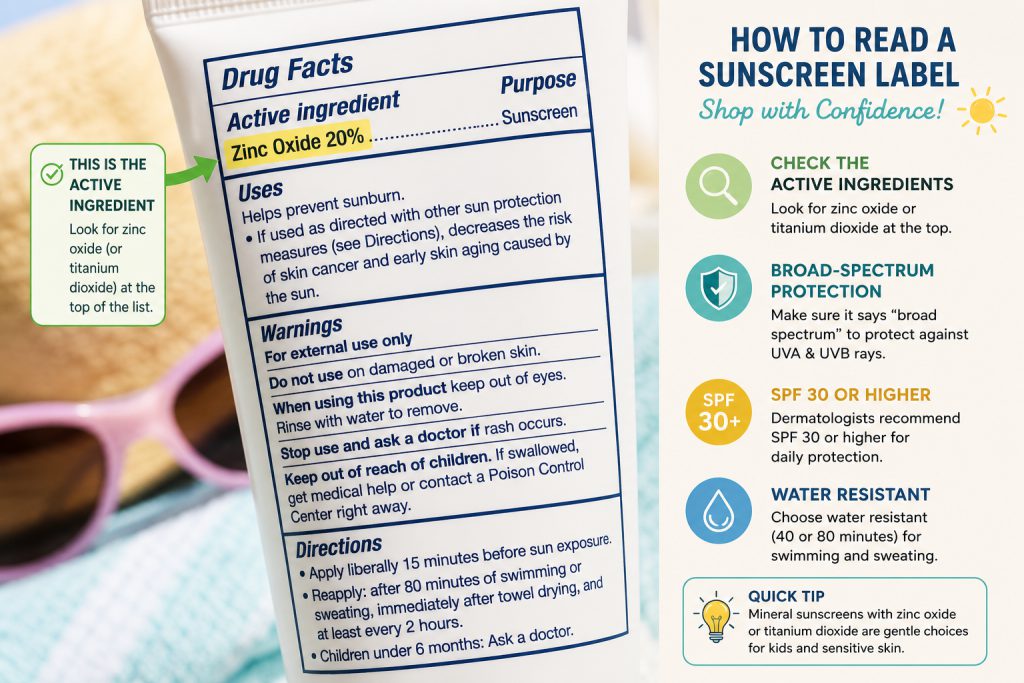
- ✓ Active ingredient is zinc oxide and/or titanium dioxide (mineral)
- ✓ Labeled “broad-spectrum” (covers both UVA and UVB rays)
- ✓ SPF 30 or higher (SPF 50 for high-UV situations)
- ✓ Water-resistant (40 or 80 minutes)
- ✓ No oxybenzone or octinoxate in the ingredient list
- ✓ No added fragrance or essential oils (especially for young children)
- ✓ Age-appropriate (check label for recommended minimum age)
Sunscreen Ingredients to Avoid for Kids
This is where a lot of parents get tripped up — and honestly, the label-reading isn’t easy. Here’s a clear breakdown of what to put back on the shelf.
Oxybenzone and Octinoxate
These two are the main ingredients to avoid, especially for young children. The U.S. Food and Drug Administration (FDA) proposed in 2019 that oxybenzone and octinoxate require additional safety data before they can be classified as Generally Recognized as Safe and Effective (GRASE). Hawaii has also banned the sale of sunscreens containing these ingredients to help protect coral reefs, making them a concern for both families and the environment.
Oxybenzone in particular has been shown to be absorbed into the bloodstream after sunscreen use, prompting the U.S. Food and Drug Administration (FDA) to call for additional safety data. Until researchers have a clearer picture of its long-term effects, many pediatricians and parents prefer mineral sunscreens for children.
Other Ingredients Pediatric Dermatologists Recommend Avoiding for Children
- Retinyl palmitate (vitamin A) — Some parents prefer to avoid sunscreens containing this ingredient because questions have been raised about how it behaves when exposed to sunlight. While the evidence remains inconclusive, choosing a simple mineral sunscreen without unnecessary additives is an easy option for young children.
- Added fragrance — A common trigger for skin irritation and allergic reactions in children. Even a “mineral” sunscreen can irritate sensitive young skin if it contains fragrance.
- Essential oils — Common in “natural” sunscreens but can cause phototoxic reactions (increased sun sensitivity) in some kids, particularly citrus-based oils.
- Octinoxate — Same concerns as oxybenzone; the FDA wants more data. Avoid for young children.
| Ingredient | Why to Avoid for Kids | How to Spot It |
|---|---|---|
| Oxybenzone | Absorbs into bloodstream; FDA flagged for more safety data needed | Listed as “benzophenone-3” or “oxybenzone” in active ingredients |
| Octinoxate | Same concerns as oxybenzone; FDA flagged | Listed as “octyl methoxycinnamate” or “octinoxate” |
| Retinyl palmitate | Some parents choose to avoid it because questions have been raised about its use in sunlight, though evidence remains inconclusive. | Look in inactive ingredients list |
| Added fragrance | Common skin irritant for children | Listed as “fragrance” or “parfum” in inactive ingredients |
| Essential oils (citrus) | Can cause phototoxic reactions | Listed by name: lemon oil, orange oil, bergamot, etc. |
Age-Based Sunscreen Selection Guide
Here’s the section most sunscreen guides skip entirely: kids at different ages genuinely need different approaches. A newborn and a ten-year-old don’t have the same needs, and the sunscreen guidance reflects that.
Newborns (0–6 Months): Sun Avoidance First
The American Academy of Pediatrics (AAP) recommends keeping babies under 6 months out of direct sunlight rather than relying on sunscreen. Their skin is thinner and more sensitive than older children’s. If adequate clothing and shade aren’t available, applying a small amount of mineral sunscreen to exposed areas such as the face and backs of the hands is considered appropriate.
Stick to shade, sun-protective clothing, and wide-brimmed hats as the primary strategy at this age. Sunscreen is the last resort, not the first line of defense.
Infants and Toddlers (6 Months–3 Years): Mineral Only
Once your baby is six months old, mineral sunscreen becomes your go-to. Look for formulas specifically labeled for babies or toddlers — these tend to have shorter, simpler ingredient lists and no fragrance. Zinc oxide at 20–25% provides excellent protection without the extras.
SPF 30–50 is the recommended range for most children. The American Academy of Dermatology recommends using a broad-spectrum sunscreen with an SPF of at least 30. While SPF values above 50 offer slightly more UVB protection, the difference is relatively small, and thicker formulas can be harder to apply evenly.
Application tip: a stick formula works well for faces at this age — faster, easier, and less likely to drip into eyes than a lotion.
For babies and toddlers, I like using a fragrance-free mineral stick sunscreen because it’s easy to apply to little faces, noses, and ears without creating a big mess.
Preschool and School-Age Kids (3–12 Years): Mineral Still Wins, Convenience Matters
At this age, your biggest challenge isn’t ingredient safety — it’s getting it on a moving target. Spray sunscreens are popular here, but they come with caveats (more on that below). Lotion remains the most reliable option for coverage.
Mineral sunscreen at SPF 30–50 is still the recommendation. If your child has eczema or chronically sensitive skin, stick with zinc oxide formulas from brands that specialize in sensitive skin — they’re worth the extra few dollars.
For older kids who spend hours outdoors, I recommend a broad-spectrum mineral lotion for school-age kids. A lotion is easier to apply generously over larger areas like arms, legs, and backs, helping you achieve the full SPF protection listed on the label.
Tweens and Teens (13+ Years): More Options, Same Principles
Older kids have more flexibility. Chemical sunscreens with avobenzone or octisalate become reasonable options — particularly for active teens who prefer a lighter, less visible formula. Reef-safe options are worth considering at this age, especially if your teen swims or surfs.
Acne-prone teens should look for non-comedogenic formulas specifically designed for face use. A lightweight mineral SPF 30 moisturizer worn daily is often the easiest habit to build.
| Age | Primary Strategy | Recommended SPF | Best Active Ingredients | Notes |
|---|---|---|---|---|
| 0–6 months | Sun avoidance + protective clothing | 30–50 if unavoidable | Mineral sunscreen (zinc oxide or titanium dioxide) | Sunscreen as last resort; prioritize shade |
| 6 months–3 years | Mineral sunscreen | 30–50 | Zinc oxide, titanium dioxide | Fragrance-free; stick formula for face |
| 3–12 years | Mineral sunscreen | 30–50 | Zinc oxide, titanium dioxide | Lotion for reliable coverage; eczema-safe options if needed |
| 13+ years | Mineral preferred; some chemical options OK | 30–50 | Zinc oxide, titanium dioxide, avobenzone | Non-comedogenic for acne-prone skin; reef-safe for swimmers |
Save or screenshot the table above — it’s designed to be your quick reference next time you’re at the store.
Our Top Brand Picks by Age and Skin Type
No brand list survives forever (formulas change), so always check the current ingredient list on whatever you buy. That said, these brands have consistently earned strong marks from pediatric dermatologists and parents alike.
| Brand / Product | Best For | Active Ingredient | Water Resistance | Price Range |
|---|---|---|---|---|
| Blue Lizard Baby | Babies and toddlers | Zinc oxide 10%, titanium dioxide 4% | 40 minutes | $$ |
| Aveeno Baby Mineral | Sensitive and eczema-prone skin | Zinc oxide 18.6% | 80 minutes | $ |
| All Good Kids Sunscreen | School-age, outdoor activities | Zinc oxide 20% | 80 minutes | $$ |
| CeraVe Mineral Sunscreen | Dry or eczema-prone skin, all ages | Zinc oxide 9.4%, titanium dioxide 6.1% | 40 minutes | $ |
| Neutrogena Pure & Free Baby | Infants and toddlers | Zinc oxide 18.6% | 80 minutes | $ |
| Supergoop! Unseen Sunscreen | Tweens and teens (clear finish) | Avobenzone 3% (chemical) | 40 minutes | $$$ |
Note: Ingredient formulas can change without notice. Always verify the active ingredients on the current packaging before purchasing.
How to Apply Sunscreen Correctly (Because Most Parents Use Too Little)
Here’s the part that surprises most parents: according to the American Academy of Dermatology, many people don’t apply enough sunscreen to achieve the SPF protection listed on the label. That means even an excellent sunscreen can provide less protection than expected if it’s applied too sparingly or unevenly.
How Much Sunscreen Should You Use?
The standard rule is one ounce — roughly a shot glass full — to cover a child’s entire body. That’s more than most parents apply. For a toddler, you’re looking at closer to half that amount, but err on the generous side.
For the face alone: a nickel-sized dollop is about right for most kids.
- Apply 15 minutes before going outside — Mineral sunscreens work immediately, but this buffer gives everything time to settle and ensures full coverage before UV exposure begins.
- Cover the easy-to-miss spots — Ears, back of the neck, tops of feet, back of the hands, and the part in the hair (especially if your child’s hair is thin or fine).
- Don’t forget the lips — An SPF lip balm protects a spot that’s easily burned and rarely sunscreened.
- Rub it in thoroughly — Mineral sunscreen especially needs to be worked in to ensure even coverage. Patchy application means patchy protection.
When to Reapply (It’s More Often Than You Think)
Reapply every two hours when outdoors, regardless of SPF. Reapply immediately after swimming, sweating heavily, or toweling off — even if less than two hours have passed.
Reapplication Checklist:
- ✓ Every 2 hours during outdoor time
- ✓ Immediately after swimming (even “water-resistant” sunscreen)
- ✓ After toweling off
- ✓ After heavy sweating (sports, playground on a hot day)
- ✓ After your child wipes their face
- ✓ Before you go back out after lunch indoors
A sunscreen stick tucked into your diaper bag, backpack, or beach tote makes mid-outing reapplication much easier—especially on little faces that won’t stay still. I keep a compact sunscreen stick on hand because it’s quick to apply, less messy than lotion, and makes it far more likely that I’ll actually remember to reapply.
Sunscreen for Special Situations
Once you’ve got the basics down, there are a handful of specific situations where parents always have follow-up questions.
Water-Resistant Sunscreen: What “80 Minutes” Actually Means
Water-resistant sunscreen is sunscreen that maintains its SPF rating for either 40 or 80 minutes of water activity — not indefinitely. After that window, it must be reapplied.
There’s no such thing as “waterproof” sunscreen. The U.S. Food and Drug Administration (FDA) no longer allows that claim because it can give a false sense of protection. Instead, look for a sunscreen labeled water-resistant for either 40 or 80 minutes, and remember to reapply as soon as that time is up or immediately after toweling off.
Sunscreen for Kids with Sensitive Skin or Eczema
If your child has eczema, look specifically for formulas with zinc oxide as the sole active, no fragrance, no essential oils, and ideally no preservatives like methylisothiazolinone (MI). Brands like CeraVe and Aveeno tend to work well for eczema-prone skin because they include skin-barrier-supporting ingredients alongside the zinc oxide.
Do a patch test on a small area of skin before the first full application — especially with a new brand. Apply to the inside of the elbow and wait 24 hours before going all in.
Sunscreen for Sports, Beach Days, and Long Outdoor Activities
For high-UV situations — peak summer sun, beach days, water parks, all-day sports — step up to SPF 50. You’ll also want the full 80-minute water-resistant rating rather than 40. A combination of sunscreen plus sun-protective clothing (rash guards, wide-brimmed hats) reduces the load on the sunscreen to do all the work alone.
For long beach days, I rely on a UPF 50+ rash guard paired with mineral sunscreen on exposed areas like the face, neck, hands, and lower legs. It reduces the amount of sunscreen you need to apply and reapply while providing excellent sun protection during hours of swimming and outdoor play.
Are Sunscreen Sprays Safe for Kids?
Spray sunscreens are convenient, but they come with real limitations. The biggest concern is inhalation. The U.S. Food and Drug Administration (FDA) advises avoiding inhalation of spray sunscreen and recommends never spraying it directly onto a child’s face. Instead, spray the sunscreen into your hands first, then gently apply it to the face. For the most reliable protection, rub spray sunscreen into the skin after application to help ensure even coverage.
Coverage is also inconsistent with sprays — it’s easy to miss spots, particularly on wiggly kids. If you use a spray, spray generously and rub it in. For children under three, stick or lotion is more reliable.
Sunscreen Mistakes Most Parents Make
You’re already doing better than most parents just by reading this far. But here are the five mistakes that show up again and again — easy to make, easy to fix.
- Applying too little. This is the number one mistake. Most parents apply roughly half of what’s needed, which significantly reduces effective SPF. A full ounce for the body isn’t as much as it sounds when you’re rubbing it in properly.
- Forgetting to reapply after water. “Water-resistant” doesn’t mean the sunscreen lasted. It means it survived water exposure for 40 or 80 minutes under test conditions. Reapply as soon as the kids are out of the water.
- Assuming cloudy days are safe. The Skin Cancer Foundation notes that up to 80% of the sun’s UV rays can pass through clouds. A cool, overcast day at the beach, playground, or park can still lead to sunburn, especially because people are less likely to reapply sunscreen or seek shade.
- Using expired sunscreen. Sunscreen degrades over time and becomes significantly less effective past its expiration date. Check the date before beach season starts every year, and replace if needed.
- Trusting “natural” labels without checking ingredients. “Natural” or “clean” sunscreens can still contain fragrance, essential oils, or inadequate zinc oxide concentrations. The label doesn’t tell you what’s inside — the ingredient list does.
Frequently Asked Questions
Can I use regular adult sunscreen on my baby?
For babies over 6 months, a fragrance-free mineral sunscreen with zinc oxide or titanium dioxide is an excellent choice. Baby-specific formulas often contain fewer potentially irritating inactive ingredients, which is why they’re commonly recommended for young children. For babies younger than 6 months, the American Academy of Pediatrics (AAP) recommends prioritizing shade, lightweight protective clothing, and wide-brimmed hats. If adequate sun protection isn’t available, a small amount of mineral sunscreen may be applied to exposed areas such as the face and backs of the hands.
Is sunscreen safe for kids to use every day?
Yes. For children who spend time outdoors, daily sunscreen use is considered safe and is recommended by pediatricians and dermatologists. Choose a broad-spectrum, mineral sunscreen with SPF 30 or higher and apply it to exposed skin whenever your child will be outside. Daily use is especially important during the spring and summer months, but UV rays can damage skin year-round—even on cloudy days. Sunscreen works best when paired with other sun-protection habits like seeking shade, wearing hats, sunglasses, and UPF clothing whenever possible.
What SPF do kids actually need?
The American Academy of Dermatology recommends choosing a broad-spectrum sunscreen with an SPF of at least 30 for children. SPF 30 filters about 97% of UVB rays, while SPF 50 filters about 98%. For everyday outdoor play, SPF 30 provides excellent protection when applied generously and reapplied every two hours. For beach days, water parks, hiking, high altitudes, or extended time outdoors, SPF 50 offers a little extra protection and is often the better choice.
Do mineral sunscreens leave a white cast?
Some do, yes — especially older formulas or high-concentration zinc oxide products. Many newer mineral sunscreens use micronized zinc oxide particles that absorb much more cleanly. If white cast is a concern, look for brands specifically marketed as “sheer” mineral sunscreens. Tinted versions are also available and popular for older kids and teens.
Is spray sunscreen safe to use on kids?
Spray sunscreens can be a convenient option for older children, but they require extra care. The U.S. Food and Drug Administration (FDA) recommends avoiding inhalation of spray sunscreen and never spraying it directly onto a child’s face. Instead, spray the sunscreen into your hands first, then apply it to the face. For younger children, lotion or stick formulas usually provide more reliable, even coverage. If you choose a spray sunscreen, rub it into the skin after application to help ensure full protection.
Can my kid still get enough vitamin D if they wear sunscreen?
According to the National Institutes of Health (NIH), most children can meet their vitamin D needs through a combination of diet, supplements when needed, and everyday sun exposure. Sunscreen remains an important part of protecting children’s skin and should not be avoided out of concern for vitamin D. If you’re worried your child isn’t getting enough vitamin D, talk with your pediatrician about whether supplementation is appropriate.
What’s the difference between water-resistant and waterproof sunscreen?
“Waterproof” sunscreen doesn’t exist. The U.S. Food and Drug Administration (FDA) no longer allows that claim because no sunscreen remains fully effective after prolonged water exposure. Instead, look for a sunscreen labeled water-resistant, which means it maintains its SPF protection for either 40 or 80 minutes while swimming or sweating. Once that time is up—or sooner if your child towels off—it’s time to reapply.
Is reef-safe sunscreen important when buying for kids?
Choosing a mineral sunscreen without oxybenzone or octinoxate is a good option if your family spends time swimming in oceans or other natural waterways. The National Park Service notes that some destinations, including Hawaii and the U.S. Virgin Islands, have restricted sunscreens containing these ingredients to help protect coral reefs. The good news is that if you’re already choosing a mineral sunscreen for your child, you’re typically making a reef-friendlier choice as well.
How do I know if my child’s sunscreen has expired?
Most sunscreens are required to maintain their SPF potency for at least three years, so the expiration date on the bottle is your clearest guide. If there’s no date, note when you opened it and replace after three years. Visible changes — separation, unusual smell, or texture changes — are also signs the formula has degraded. When in doubt, replace it.
What should I do if my child gets sunburned despite wearing sunscreen?
First, get your child out of the sun right away. Cool the skin with a cool (not icy) bath or compress, then apply aloe vera gel or a gentle, fragrance-free moisturizer to help soothe the burn. Encourage plenty of fluids to prevent dehydration. According to the American Academy of Pediatrics (AAP), you should contact your pediatrician if your child develops severe blistering, fever, chills, significant pain, or signs of dehydration or heat-related illness.
You’ve Got This — Here’s What to Remember
Sun protection for kids doesn’t need to be complicated. Mineral sunscreen with zinc oxide, SPF 30 or higher, applied generously and reapplied every two hours — that’s really the core of it. Everything else is just fine-tuning for your specific kid and situation.
Most parents are already doing more right than they realize. You’re asking the right questions, reading the labels, and showing up with sunscreen at the pool. That counts for a lot.
Pick one thing from this guide to start with — whether that’s swapping to a mineral formula, setting a reapplication timer, or finally using a full ounce instead of half — and build from there. Small habit shifts add up to a lifetime of protected skin for your kids.
Save this guide for your next sunscreen shopping trip, share it with another parent who’s been asking the same questions, or drop a comment below with the brand that’s been working for your family.
Keep Kids Safe for Every Outdoor Adventure
Sunscreen is just one part of protecting your family outdoors. Whether you’re heading to the beach, the campground, or a day at the water park, these guides will help you stay prepared.
- Don’t forget the essentials with this complete river day packing checklist for families.
- Plan a fun and sun-safe water park trip with these practical family tips.
- Find the best swimming floats to help kids stay safe and confident in the water.
- Make your next camping trip easier with smart family camping tips and packing ideas.


