
How to Stop Nail Biting in Kids (Parent’s Complete Guide)
Quick Answer: To stop nail biting in kids, start by identifying the cause — stress, boredom, sensory seeking, imitation, or pure habit. Match your strategy to the root cause. Most kids respond well to awareness techniques, replacement behaviors, and positive reinforcement within four to eight weeks. Punishment and shame make the behavior worse, not better.
You glance over at your child and notice their fingers are in their mouth — again. The nails are ragged, the skin around them is red, and you’ve already said “stop biting your nails” more times than you can count. Nothing sticks.
Nail biting in kids is one of the most common childhood habits, affecting an estimated 20 to 33 percent of children at some point. (American Academy of Pediatrics) The problem isn’t that your child lacks willpower or isn’t listening. The problem is that most advice skips the most important step: figuring out why your child is biting their nails in the first place. Different causes need different solutions. When you nail down the root cause, the right strategy becomes a lot clearer.
Biting nails can sometimes lead to infections, nail damage, or signal anxiety worth addressing. But the good news is that most kids stop with the right approach — and that approach doesn’t involve frustration, constant reminders, or making your child feel bad about themselves.
Here’s exactly what’s driving the behavior, how to spot which cause fits your child, and a step-by-step strategy for each one—so you can stop guessing and start seeing real change. If your child struggles with big feelings in general, these emotional regulation strategies for kids can make habits like nail biting much easier to overcome.
Heads up: This post may include affiliate links. As an Amazon Associate, I earn from qualifying purchases—at no extra cost to you. Full privacy policy and disclosure here.
Why Your Child Bites Their Nails (And What It Really Means)
Nail biting — clinically called onychophagia — is a body-focused repetitive behavior (BFRB). That sounds clinical, but what it really means is this: your child’s body has found a way to self-regulate, and biting nails is the outlet it landed on. It’s not defiance. It’s not a character flaw. It’s communication.
Is Nail Biting Normal?
Completely. Nail biting typically starts between ages 3 and 6, peaks during the school-age years, and remains common into adolescence. (American Academy of Pediatrics) It shows up in kids who are anxious and in kids who are perfectly calm. It happens in children who are bored and in kids who are overstimulated. The habit itself doesn’t tell you much—the trigger does.
| Age Range | What’s Typical | When to Take Note |
|---|---|---|
| Toddlers (2–3) | Mouthing behaviors are normal; nail biting is less common | Persistent biting with bleeding or distress |
| Preschool (3–5) | Habit onset common; often linked to transitions (new sibling, starting school) | Biting combined with other anxiety signs (sleep disruption, withdrawal) |
| School-age (6–12) | Peak nail biting age; stress and boredom are common triggers | Skin picking, bleeding regularly, or social impact |
| Teens (13+) | May persist from earlier habit; stress-linked | Nail biting alongside anxiety disorder symptoms or dermatophagia |
The 5 Root Causes of Nail Biting in Kids
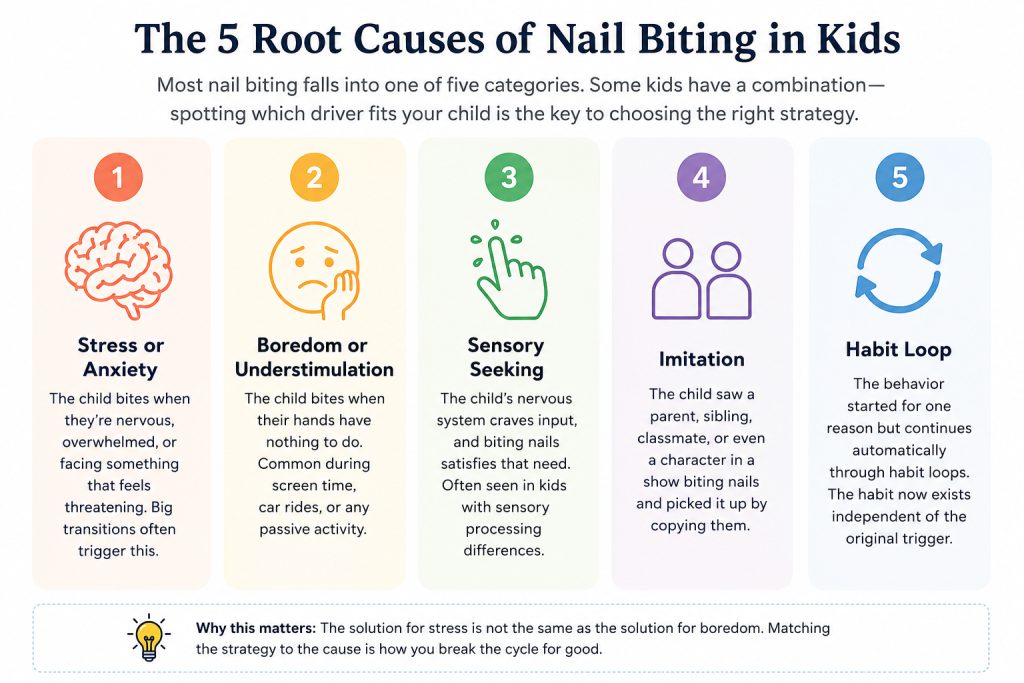
Most nail biting falls into one of five categories. Some kids have a combination — a child who started biting under stress may now do it out of pure habit, even when life is calm. Spotting which driver fits your child is the key to choosing the right strategy.
- Stress or anxiety — The child bites when they’re nervous, overwhelmed, or facing something that feels threatening. Big transitions (new school, moving, a new sibling) often trigger this.
- Boredom or understimulation — The child bites when their hands have nothing to do. Common during screen time, car rides, or any passive activity.
- Sensory seeking — The child’s nervous system craves input, and biting nails satisfies that need. Often seen in kids with sensory processing differences.
- Imitation — The child saw a parent, sibling, classmate, or even a character in a show biting nails and picked it up by copying them.
- Pure habit — The behavior started for a reason but is now completely automatic. The child often doesn’t even realize they’re doing it.
The Real Health Risks — And When to Actually Worry
Most nail biting is minor and doesn’t cause lasting harm. But it’s worth knowing when to pay closer attention.
Can Nail Biting Cause Infection?
Yes, it can—though serious infections aren’t common with light biting. When nails are bitten down to the quick or the skin around the nail bed breaks open, bacteria from the mouth (and everything the child’s hands have touched) can enter. Signs of infection include increasing redness, swelling around the nail, warmth, pus, or pain that doesn’t improve. If you see those signs, a pediatrician visit is the right call. (American Academy of Dermatology)
When Should I Call the Pediatrician?
Most nail biting doesn’t require a doctor’s visit. But reach out to your pediatrician if:
- Your child’s nails or surrounding skin show signs of infection (redness, swelling, warmth, pus)
- Nail biting is so severe it’s interfering with daily function — school, eating, socializing
- The behavior is accompanied by other anxiety signs: sleep problems, persistent worry, withdrawal, stomachaches with no physical cause
- You suspect the biting has progressed to dermatophagia (biting and eating the skin around the nails)
- Nothing you’ve tried has made a dent after six to eight weeks of consistent effort
What If My Child Is Drawing Blood?
Clean the area gently and keep it covered until it heals. A bandage on the affected finger can also serve as a physical reminder not to bite. If bleeding is happening regularly, treat the wound and step up your strategy—this is a sign the habit has progressed beyond mild. A pediatrician can help assess whether a referral to a child therapist or behavioral specialist is the right next step. (American Academy of Pediatrics)
The 5-Step Strategy to Stop Nail Biting (Matched to What’s Causing It)
Here’s what most advice misses: one strategy does not fit every child. A fidget toy won’t help a child biting from anxiety. A calming technique won’t help a sensory seeker. Using the right tool for the right cause is what makes the difference.
Use this table to identify your child’s driver, then jump to the corresponding strategy below.
| Root Cause | Signs to Look For | Go-To Strategy |
|---|---|---|
| Stress or Anxiety | Biting increases before school, during arguments, before transitions; child seems worried or on edge | Calming techniques + emotional check-ins + consider therapy if persistent |
| Boredom | Biting happens during passive activities: screen time, car rides, quiet tasks | Replacement activities + hand engagement strategies |
| Sensory Seeking | Child loves chewing, squeezing, or touching textures; biting seems satisfying, not nervous | Sensory substitutes + occupational therapy input if needed |
| Imitation | Started after seeing a sibling, parent, or peer bite their nails | Model alternative behavior; address the social dynamic directly |
| Pure Habit | Child bites automatically, often without realizing; no clear trigger pattern | Awareness training + habit reversal + replacement behavior |
Strategy 1: If It’s Stress or Anxiety
Stress-driven nail biting is the child’s nervous system looking for relief. The biting is working — it’s regulating their emotions in the moment. That’s why telling them to stop without offering another outlet rarely succeeds.
Signs Your Child Is Stress-Biting
- Biting spikes at predictable high-stress moments: Sunday nights before school, before a test, after a conflict
- The child also shows other signs of worry: stomachaches, sleep trouble, clinginess, withdrawal
- They can tell you they feel nervous or scared when asked — or they go quiet and shut down
- The habit started during or after a major life change
Is This Stress-Biting? Quick Checklist
- ☐ Does biting increase before school or social situations?
- ☐ Did the habit start after a big change (new school, move, new sibling, family stress)?
- ☐ Does your child mention feeling nervous or worried often?
- ☐ Are there other body-focused behaviors like hair twisting, skin picking, or thumb sucking?
- ☐ Does biting seem to calm them down in the moment?
If you checked three or more, stress is likely the main driver.
Calming Techniques That Actually Help
The goal is to give your child a different regulation tool — one that serves the same emotional function as the biting, without the physical harm.
- Belly breathing: Simple box breathing or “smell the flowers, blow out the candles” exercises for younger kids
- Squeeze tools: A stress ball, a small piece of putty, or a textured gel fidget kept in their pocket for anxious moments
- Scheduled emotional check-ins: Five minutes after school to ask how they’re feeling — not “how was your day” but “what was hard today?”
- Anticipation prep: Many parents also find it helpful to create a calming routine before stressful situations. These no-yelling parenting tools can help everyone stay calmer during difficult moments.
If anxiety seems to be fueling the habit, these practical emotional regulation strategies for kids can help your child build healthier coping skills.
When to Involve a Therapist
If the anxiety driving the biting feels persistent—not just occasional nerves, but ongoing worry that’s affecting your child’s sleep, friendships, or willingness to try new things—a child therapist or psychologist is worth bringing in. Cognitive behavioral therapy (CBT) is highly effective for anxiety-driven body-focused repetitive behaviors (BFRBs) in children. (American Psychological Association) Your pediatrician can refer you, or you can search for a licensed child therapist in your area.
Strategy 2: If It’s Boredom
Boredom biters aren’t anxious — they’re understimulated. Their hands need something to do, and biting fills that gap. This is actually good news: the fix is simpler than anxiety-driven biting, and there are a lot of great alternatives.
Why Some Kids Bite When Understimulated
The brain naturally seeks stimulation, especially in kids with active, curious minds. During passive activities—like watching TV, riding in the car, or sitting through a long lesson—it’s common for children to look for something to keep their hands busy. Nail biting is easy, always available, and provides enough sensory feedback to become an automatic habit over time. (Society for Research in Child Development)
Replacement Activities That Satisfy the Urge
- Keep a small fidget toy in the car, the school bag, and near the TV spot — the goal is making the alternative more convenient than the biting
- Offer something to hold during screen time: a textured pillow, a stress ball, a piece of craft cord to braid
- For older kids, try worry beads, a fidget ring, or a small desktop toy they can spin or squeeze without thinking about it
- Channel the energy during car rides with simple hand games, hand massages with lotion, or squeezing activities.
Remember that boredom isn’t always a bad thing. In fact, allowing kids to experience boredom often encourages creativity while reducing reliance on automatic habits. A small sensory fidget toy can help keep busy hands occupied during screen time, homework, or car rides. This sensory fidget toy set is a great option for home or school.
Strategy 3: If It’s Sensory Seeking
Sensory seekers are a specific group, and they need a specific approach. These are children whose nervous systems genuinely crave input — texture, pressure, resistance — and biting nails delivers exactly that. They may also chew on shirt collars, pencils, or food in a way that’s more intense than other kids. This isn’t a behavioral issue; it’s a sensory one.
Why Sensory Seekers Bite Their Nails
Sensory processing refers to how the nervous system receives, organizes, and responds to sensory information from both the environment and the body. Some children naturally seek more proprioceptive input—the deep pressure sensations that come from activities like pushing, pulling, chewing, or biting—to help themselves feel calm, organized, and alert. (American Occupational Therapy Association) In these cases, nail biting isn’t necessarily an emotional response; it’s often the child’s way of meeting a genuine sensory need.
Safe Sensory Alternatives by Type
| Sensory Type | What They Crave | Alternative Tools |
|---|---|---|
| Oral sensory seekers | Chewing, biting, crunching textures | Chewable jewelry (chew necklaces, chew pencil toppers), crunchy snacks at structured times, gum for older kids |
| Tactile sensory seekers | Touching varied textures, squeezing | Kinetic sand, slime, textured fidget tools, therapy putty in varying resistances |
| Proprioceptive seekers | Heavy work, resistance, pressure | Squeezing a stress ball, carrying a heavy backpack, wall push-ups, fidget tools with resistance |
Many children who seek extra sensory input also benefit from regular movement breaks and proprioceptive play. Try these body awareness activities to naturally meet those sensory needs throughout the day.
These silicone chew necklaces provide safe oral sensory input for children who naturally seek chewing as a way to regulate their nervous system.
For children who enjoy squeezing and resistance activities, therapy putty is another excellent option that keeps hands busy while strengthening fine motor skills.
Strategy 4: If It’s Imitation
Kids are wired to copy. If your child watched a parent, older sibling, classmate, or even a YouTube character biting their nails, they may have picked it up the same way they learn everything else: by observing and repeating. The good news is that imitation-based habits haven’t had time to develop deep neural grooves — they’re often the easiest to redirect.
How Imitation Nail Biting Works
Children’s brains have a powerful ability to learn through observation. When they watch someone perform a behavior, networks of brain cells often referred to as the mirror neuron system become active, helping them imitate actions and learn new skills. (Encyclopaedia Britannica – Mirror Neuron) This is one of the ways children learn language, social skills, and—sometimes—habits you’d rather they hadn’t picked up.
What to Do About It
- Model the alternative directly. If the person they copied is still biting (you, a sibling), work on the habit together. Make it a family challenge, not a correction aimed only at the child.
- Address the social angle honestly. For school-age kids, it’s okay to say: “You might have picked that up from watching someone else. It’s really common. Now let’s try something different together.”
- Avoid blame. Telling a child they picked up a bad habit from their sibling can create conflict. Keep the conversation focused on the child in front of you.
- Replace the behavior early. Because the habit is newer, introducing a replacement quickly — before the pattern becomes automatic — is especially effective here.
Strategy 5: If It’s Just a Habit Now
Sometimes nail biting started for a reason — but that reason is long gone. Now it’s just automatic. The child might do it during homework, in the car, during dinner, without any awareness at all. This is a habit loop at work, and breaking it takes a specific approach: not willpower, but awareness plus replacement.
How Habits Stick (The Habit Loop)
Every habit follows a simple three-part loop: a cue (a situation, emotion, or time of day), a routine (the behavior—in this case, nail biting), and a reward (the brief relief or satisfaction the behavior provides). (MIT News) The key to breaking a habit isn’t eliminating the cue or the reward—it’s replacing the routine with a healthier behavior that offers a similar sense of relief or satisfaction.
Awareness Training: The First Step
Most automatic biters genuinely don’t know they’re doing it. Building awareness — without shame — is the foundation of habit reversal.
- Introduce a gentle signal. Agree on a private cue with your child — a light tap on the shoulder, a hand signal, or a code word — that you’ll use when you notice them biting. Make it neutral, not corrective.
- Start a trigger tracker. Together, help your child notice when the biting happens. Is it always during homework? TV? Bedtime? Patterns become visible quickly, and kids often find this interesting rather than shaming.
- Make it collaborative. Frame it as detective work: “Let’s figure out when your hands like to sneak into your mouth. No big deal — we’re just watching.”
Free Printable: Download the Nail Biting Trigger Tracker to help your child identify when the habit happens, what they were feeling, and which replacement strategies worked best. Tracking patterns is often the first step toward lasting change.
Replacement Behaviors That Work
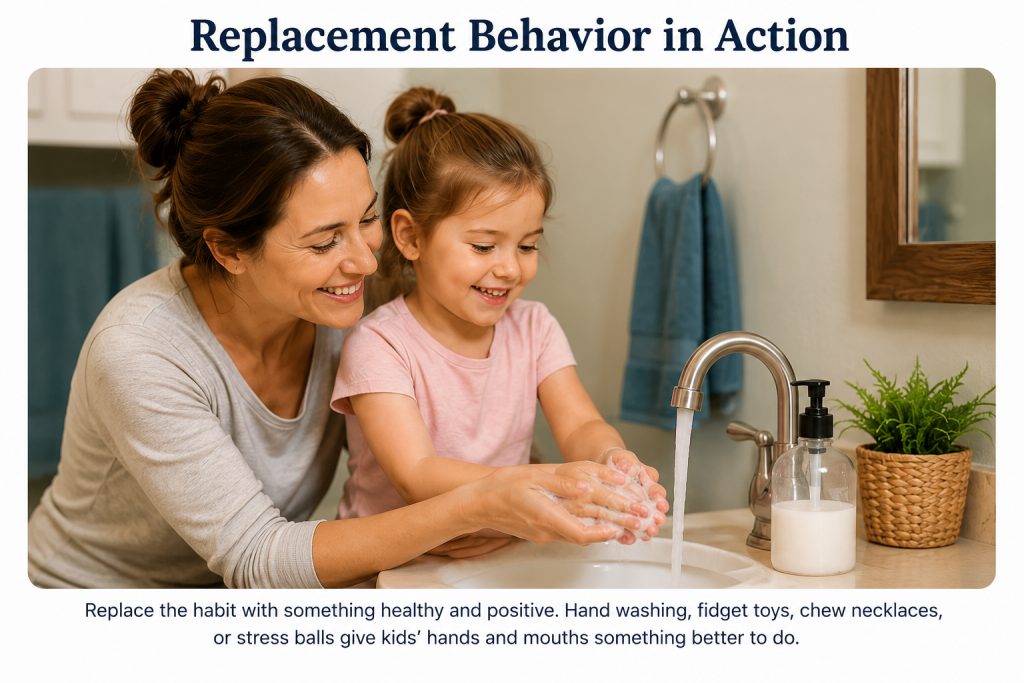
Once you know the triggers, introduce a competing response — something the child does instead of biting the moment the urge hits. Good competing responses are incompatible with nail biting (you can’t do both at once) and give a similar sensory payoff.
- Pressing both hands flat on a table or thighs
- Squeezing a stress ball or fidget tool
- Running a thumb over the fingernails (feeling them, not biting)
- Applying a scented hand cream — the ritual of rubbing it in occupies the hands, and the smell adds a sensory cue that signals “not biting time”
Applying a kid-safe scented hand cream creates a simple replacement routine while keeping dry cuticles moisturized and less tempting to pick or bite.
Building New Automatic Patterns
Habits can take anywhere from about 21 to 66 days to become automatic, depending on the individual and the complexity of the behavior. (Lally et al., European Journal of Social Psychology, 2010) Expect the process of breaking a nail-biting habit to take four to eight weeks of consistent effort. Celebrate small wins along the way—like noticing the urge to bite or choosing a replacement behavior—not just longer nails. Remember that setbacks are a normal part of habit change and don’t erase the progress your child has already made.
If your child has several repetitive habits—not just nail biting—you may also find this guide to common childhood habits helpful.
What NOT to Do: Common Mistakes That Make It Worse
Most parents try at least a few of these before finding what works. None of them are failures — they’re just not the most effective tools. Here’s what to skip.
Don’t Shame or Punish
Punishment increases stress — which, for many biters, is the very thing driving the behavior. Scolding, taking away privileges for biting, or embarrassing your child in front of others will deepen the anxiety that feeds the habit. It also damages the trust you need to work through it together.
Positive discipline is far more effective than punishment for changing long-term behavior. These discipline strategies without punishment are a great place to start.
Don’t Use Bitter Nail Polish as Your Only Strategy
Bitter-tasting polish (like Mavala Stop or similar products) can work as an in-the-moment reminder, but it treats the symptom, not the cause. The moment you stop using it, the biting returns — because nothing underlying has changed. If you use it, pair it with one of the root-cause strategies above. Think of it as a training wheel, not a solution.
If you choose to try a bitter nail polish designed to discourage nail biting, use it alongside one of the root-cause strategies above. Think of it as a training wheel—not the entire solution.
Don’t Compare to Other Kids
“Your brother doesn’t bite his nails” is a sentence that has never once helped a child stop biting their nails. Comparison generates shame and resentment, not motivation.
Don’t Assume One Strategy Fits All
A fidget toy that worked for your neighbor’s kid might do nothing for yours. That’s not because fidget toys don’t work — it’s because your child might have a different root cause. Go back to the table above if your first attempt doesn’t gain traction.
Don’t Expect Overnight Results
The habit took weeks or months to form. It won’t dissolve in three days. Parents who quit a strategy after a week because “it’s not working” often abandon the approach right before it would have taken hold. Give any strategy at least four weeks of consistent use before reassessing.
Helpful Products for Kids Who Bite Their Nails
Nail Care Products
Keeping your child’s nails trimmed, smooth, and moisturized removes many of the little triggers that encourage nail biting. Jagged edges, peeling skin, and rough cuticles practically invite kids to keep picking and chewing. A simple nail care routine every week can make a noticeable difference while your child works on breaking the habit.
- Kid-Safe Nail Care Kit — Includes gentle tools designed for little hands, making regular nail trimming easier and less stressful than using adult grooming tools.
- Glass Nail File for Kids — Glass files create a much smoother edge than traditional emery boards, helping eliminate rough spots that children often feel tempted to bite.
- Cuticle Cream — Moisturizing dry skin around the nails helps prevent peeling and hangnails that often trigger more biting and picking.
Making nail care part of your weekly routine—perhaps after bath time or before bed on Sunday evenings—can become another positive habit that supports healthier hands.
Tracking and Reward Systems
For younger children, a visual reward system can bridge the gap while habits are shifting. The key is rewarding effort and awareness, not just nail length — otherwise kids feel punished for slipping up.
- Simple sticker charts work well for ages 4–8: one sticker for each hour or day without biting, with a small reward at a milestone
- A “nail check” before bedtime — a calm, positive moment to look at their nails together — builds awareness without nagging
Frequently Asked Questions About Nail Biting in Kids
Is nail biting a sign of ADHD or anxiety in children?
It can be connected to anxiety, but nail biting isn’t a diagnostic sign of either ADHD or an anxiety disorder on its own. It’s a common habit seen in neurotypical children as well as children with ADHD, anxiety, or sensory processing differences. If nail biting is accompanied by persistent worry, sleep problems, avoidance behaviors, or frequent physical complaints like stomachaches, it’s worth mentioning at your child’s next pediatric appointment. (American Academy of Pediatrics)
How long does it take to stop nail biting in kids?
Most children show meaningful improvement within four to eight weeks of consistently using the right strategy. Research on habit formation suggests that habits typically take between 21 and 66 days to become automatic, depending on the individual and the complexity of the behavior. (Lally et al., European Journal of Social Psychology, 2010) Setbacks are a normal part of the process—they don’t erase the progress your child has already made. Stay consistent, celebrate small victories, and focus on gradual improvement rather than expecting the habit to disappear overnight.
Can nail biting cause serious infections?
Infections are possible but aren’t common with mild nail biting. However, when the skin around the nail bed breaks open, bacteria can enter and increase the risk of infection. Watch for spreading redness, swelling, warmth, pus, or pain that gets worse instead of better. These signs should be evaluated by a healthcare provider. Keeping the affected area clean, dry, and covered while it heals can help reduce the risk of complications. (American Academy of Dermatology)
What if my child bites their nails and the skin around them?
This is called dermatophagia, a body-focused repetitive behavior (BFRB) that involves biting or chewing the skin around the fingers. It carries a higher risk of infection than nail biting alone and can be more challenging to overcome. Use the same root-cause strategies discussed above, but consider involving a child therapist sooner if the behavior is persistent or causing injury. A therapist trained in habit reversal training (HRT) or cognitive behavioral therapy (CBT) can often help children develop healthier coping strategies. (TLC Foundation for Body-Focused Repetitive Behaviors)
Should I punish my child for nail biting?
No. Punishment increases stress, which is one of the most common drivers of nail biting. It also creates shame and can damage the trust you need to work through the habit together. Positive reinforcement, awareness training, and replacement behaviors work better and don’t carry the emotional costs of punishment.
Do kids grow out of nail biting on their own?
Some children do naturally outgrow nail biting as they mature and develop stronger coping skills. However, not every child will stop without support, and habits that continue into the teen years often become more deeply ingrained over time. Addressing the root cause early—whether it’s anxiety, boredom, sensory needs, or simple habit—can make the behavior much easier to change. (American Academy of Pediatrics)
Is bitter nail polish effective for kids?
It can help as a sensory reminder not to bite, but it’s not effective on its own. Bitter polish treats the symptom, not the cause. Once you stop using it, the biting typically returns unless the underlying trigger has also been addressed. Use it as a supporting tool alongside a root-cause strategy — not as a standalone solution.
What if my child’s nails look damaged or misshapen from biting?
Chronic nail biting can sometimes cause ridging, discoloration, or changes in how the nail grows. Fortunately, fingernails regenerate over time, and most nail damage improves once the biting habit stops. Because fingernails typically take about three to six months to grow out completely, it may take a little while to see healthy new nail growth. If nail changes persist even after your child has stopped biting, it’s a good idea to mention them to your pediatrician. (American Academy of Dermatology)
When should I get professional help for my child’s nail biting?
Consider involving a professional if the nail biting is causing frequent bleeding or infections, is accompanied by significant anxiety or other body-focused repetitive behaviors (BFRBs), is affecting your child’s confidence or social life, or hasn’t improved after six to eight weeks of consistent strategies at home. Your pediatrician can help determine whether a referral to a child psychologist, occupational therapist, or behavioral specialist would be beneficial. (American Academy of Pediatrics)
How do I know if it’s a nervous habit or a bigger problem?
Light, occasional biting is a normal childhood habit. It becomes a bigger concern when nails are regularly bitten raw or bloody, when the behavior seems compulsive and distressing to the child, when the child can’t stop even when they want to, or when it’s paired with other signs of anxiety or distress. If you’re unsure, bring it up at your next pediatric visit — that’s exactly what those appointments are for.
Key Takeaways
- Nail biting in kids is driven by one of five root causes: stress, boredom, sensory seeking, imitation, or habit. Matching your strategy to the right cause makes all the difference.
- Punishment and shame make nail biting worse, not better. The behavior is the child’s nervous system communicating — listen to it rather than shutting it down.
- Awareness training plus replacement behavior is the most effective approach for ingrained habits, and most children respond within four to eight weeks of consistent effort.
- Health risks are usually minor, but watch for infection signs, especially if the skin around the nail breaks open regularly.
- If nail biting is accompanied by persistent anxiety, other body-focused repetitive behaviors, or is affecting your child’s life, a pediatrician or child therapist is a worthwhile next step.


