How to Raise a Strong-Willed Child Without Endless Power Struggles
Quick Answer: A strong-willed child isn’t defiant by nature — they’re wired for conviction. Positive parenting means setting firm boundaries while honoring their need for autonomy, offering choices within limits, using natural consequences, and celebrating their leadership traits. The goal isn’t compliance; it’s partnership.
If your kid argues about everything, questions every rule, and pushes back on bedtime with lawyerly precision — you’re not failing. You’re parenting a spirited kid who will become an incredible adult.
Power struggles are exhausting. You worry that saying “no” will crush their spirit, but saying “yes” to everything teaches nothing. Most parenting advice feels like it’s designed for compliant kids, and your kid doesn’t fit the mold.
Here’s the truth: your child’s strong will isn’t a problem to fix. It’s a temperament trait to channel. There’s a real difference between a defiant kid and a strong-willed one, and that difference changes everything about how you parent.
This guide gives you a framework to see your child’s strong will as their superpower, plus five specific strategies that work with their nature instead of against it. By the end, you’ll have a clear, confident plan for parenting without endless battles — and you’ll start looking forward to raising someone with this much conviction.
Heads up: This post may include affiliate links. As an Amazon Associate, I earn from qualifying purchases—at no extra cost to you. Full privacy policy and disclosure here.
What Is a Strong-Willed Child? (It’s Not What You Think)
A strong-willed child is a kid wired with a powerful need for autonomy, conviction, and logical consistency. They question rules, negotiate boundaries, and push back on directives they don’t understand or agree with. This isn’t defiance — it’s temperament.
Every child has an inborn temperament. Some kids are naturally easy-going and adaptable. Others are more spirited, intense, or independent. In the landmark New York Longitudinal Study, developmental psychiatrists Alexander Thomas and Stella Chess found that about 65% of children fit into one of three broad temperament patterns: approximately 40% were “easy,” 10% were classified as “difficult,” and 15% were “slow-to-warm-up.” Although the term “difficult” appeared in the original research, many parenting experts today prefer more strengths-based language, such as spirited or strong-willed. Source: OpenStax – Lifespan Development (Thomas & Chess temperament research).
A strong-willed child isn’t trying to drive you crazy. They’re being true to who they are. Understanding this difference is the turning point where parenting stops feeling like a battle and starts feeling like partnership.
The Difference Between Strong-Willed and Defiant
This distinction matters because it changes how you respond.
A strong-willed child questions your authority because they want to understand the logic behind the rule. They argue because they’re thinking, weighing, and testing whether your expectation makes sense. They resist control because they have a genuine need for autonomy. Even when they comply, they want to know why.
A defiant child refuses to follow rules primarily to challenge your authority or avoid compliance. Defiance is often about power and control; strong-will is about logic and autonomy. Defiant behavior is usually a response to something — anger, shame, feeling disrespected. A strong-willed temperament is just how the kid is wired.
Here’s an example: You say, “Bedtime is 8 p.m.” A strong-willed child asks, “Why 8 and not 8:30? I’m not even tired.” A defiant child says, “No. I’m not going to bed,” and refuses to engage further.
Both need a clear boundary. But a strong-willed child is looking for logic and respect; a defiant child is looking for a power win. Your response should match what’s actually happening.
Why Temperament Matters (It’s Not Your Parenting)
Many parents of strong-willed kids carry guilt. They think, If I were a better parent, my kid would just listen. That’s not how temperament works.
Temperament is inborn. It’s the hardwiring your child was born with. You didn’t cause it. You can’t shame it away. And reward-and-punishment systems won’t reshape it because strong-willed kids aren’t motivated by the same levers as other kids.
A compliant child might work hard for a gold star. A strong-willed child will take the gold star and ask, “But why do I have to do this if the gold star is the only reason?” They’re not being difficult; they’re being logical. The question of intrinsic motivation has landed, and they’ve already spotted the gap.
This is where traditional parenting advice breaks down. It’s not that your parenting is wrong; it’s that your kid’s temperament needs a different approach. Once you accept that, everything shifts.
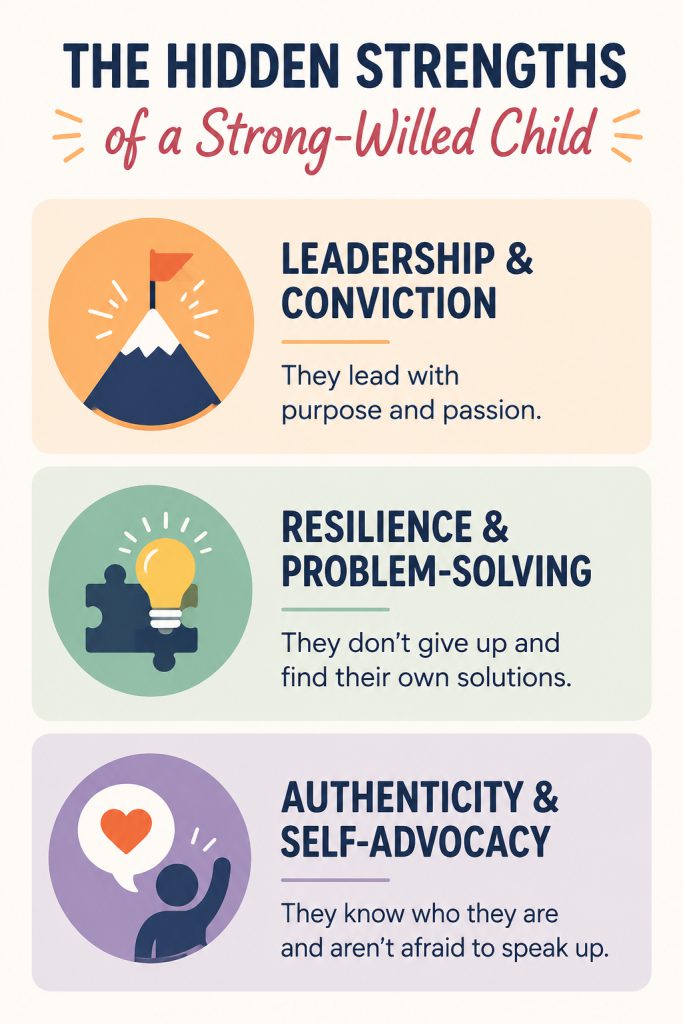
The Hidden Strengths of a Strong-Willed Child
Before we talk about strategies, we need to reframe what strong-will actually is. Most articles about strong-willed kids focus on the challenge. But what if the challenge is actually the gift?
Strong-willed kids have superpowers that will serve them for life. They’re not broken. They’re not difficult. They’re wired in a way that, when nurtured, creates adults with conviction, resilience, and authenticity. The world needs these people.
The challenge for you right now is simple: honor these traits while still being the parent. That’s it. And it’s totally possible.
Leadership & Conviction
Strong-willed kids don’t follow the crowd because they can’t see the point. They ask why instead of just complying. As adults, this becomes leadership. They become the people who question bad systems, who don’t cave to peer pressure, and who stand by their convictions even when it’s hard.
Right now, your 7-year-old is arguing about homework. In 15 years, they’ll be the person who challenges an unjust policy at school. In 25 years, they’ll be the coworker who speaks up in meetings when something doesn’t make sense. That arguing muscle? It’s a future asset.
Resilience & Problem-Solving
Strong-willed kids don’t give up easily. They’re wired to push back, to test, to try another angle. This means they develop incredible resilience. When something doesn’t work, they don’t crumble; they try the next thing.
They also become natural problem-solvers because they’re always asking, “Is there a better way?” That questioning, testing mind is a strength when it’s channeled well. Adults with this trait become innovators, troubleshooters, and people who don’t accept the status quo just because that’s how it’s always been done.
Authenticity & Self-Advocacy
A strong-willed child won’t pretend to be someone they’re not to make you happy. They won’t fake compliance to get approval. They’re deeply themselves, which can feel intense right now — but it means they’ll grow into adults who know themselves, advocate for their own needs, and don’t waste energy performing for others.
These are the kids who tell you honestly how they feel, who express their opinions, who ask for what they need. Yes, it’s exhausting when you’re parenting it. But you’re raising someone who will never be lost trying to figure out who they are or what they believe.
Why Traditional Parenting Advice Doesn’t Work (And Why Your Kid Needs Something Different)
Most mainstream parenting strategies are built on a reward-and-consequence model: Do what I ask, and you get a reward. Don’t do it, and you lose something. This works beautifully with compliant kids because they’re naturally motivated by external approval and external rewards.
Strong-willed kids? They see right through it. They ask, “But why should I care about your gold star?” Or they bargain: “I’ll do it if you give me two gold stars.” Or they negotiate: “I’ll do half now and half later.” They’re not being difficult; they’re questioning the system itself.
This is where parents of strong-willed kids get stuck. You’re following parenting advice that’s not designed for your kid’s temperament. You’re using tools that don’t fit. No wonder you’re exhausted.
What strong-willed kids actually respond to is logic, respect, and partnership. They need to understand the “why” behind your boundary. They need to feel heard even when the answer is still no. And they need some autonomy in how the boundary is executed.
That’s a different parenting framework. And it works.
If you’re looking for step-by-step coaching rather than piecing strategies together yourself, the Positive Parenting Solutions course walks parents through power struggles, respectful discipline, emotional regulation, and raising strong-willed kids.
The Strength Profile Framework: Know Your Child’s Superpower
Here’s where everything clicks into place. Instead of trying to force your strong-willed child to fit a parenting model designed for someone else, we’re going to identify their specific flavor of strong-will and match your parenting strategy to it.
Not all strong-willed kids are the same. Some are natural leaders. Some are negotiators who need to argue everything through logic. Some are pioneers who just need to test every boundary. Knowing which one you’re raising changes how you approach discipline, autonomy, and connection.
Part 1: Identify Your Child’s Profile (Leader / Negotiator / Pioneer)
Read through these three profiles. Your kid might fit one clearly, or they might be a blend of two. That’s normal. The point is to recognize their core drive.
The Leader: Your child naturally wants to be in charge. They organize other kids, make decisions, and want decision-making power in your family too. They’re commanding, visionary, and they hate being told what to do without input. They challenge you because they want to be part of the decision, not bossed around.
The Negotiator: Your child is logical and debate-driven. They argue to understand, to find the flaw in your logic, to see if there’s wiggle room. They respect a well-reasoned argument more than an authority figure. They ask “why” constantly and will accept your boundary if the logic holds up.
The Pioneer: Your child needs to test boundaries and figure out the world through experimentation. They’re independent, curious, and they’ll ignore a rule just to see what happens. They learn by doing, not by being told. They need freedom to explore, but within very clear limits.
Which one sounds like your kid?
The “Is My Child Strong-Willed?” Checklist
- My child questions rules instead of automatically following them.
- Power struggles are a regular part of our routine.
- My child needs to understand the “why” behind my requests.
- They negotiate, argue, or push back on most directives.
- My child has a strong sense of what they do and don’t want.
- Praise and rewards don’t motivate them the way they do other kids.
- My child is intense — their emotions, their opinions, their needs are all very clear.
- They’re driven by autonomy; they hate being controlled.
- When they’re interested in something, they pursue it with amazing focus.
- My child speaks up for themselves without waiting for permission.
- Punishment and consequences don’t seem to change their behavior much.
- My child is honest, sometimes painfully so.
- They test limits constantly, even boundaries they know.
- My child is happier and more compliant when they feel respected, not controlled.
- Other parents often comment that my child is “spirited” or “strong-willed.”
If most of these sound familiar, you’re raising a strong-willed kid. And now we know what to do about it.
Part 2: Match Your Strategy to Their Profile
Once you know whether you’re raising a Leader, Negotiator, or Pioneer, you can tailor your approach.
| Profile | What They Need | How to Respond |
|---|---|---|
| The Leader | Input, control, respect for their perspective | Give them decision-making power within your boundaries. “You’re in charge of when you do homework (before 7 p.m.), you pick the order.” |
| The Negotiator | Logic, explanation, the reasoning behind rules | Explain the “why” clearly. Respect their questions. If they can poke holes in your logic, acknowledge it. “You made a good point. Here’s what we’re doing anyway, and here’s why.” |
| The Pioneer | Freedom to explore within clear, non-negotiable limits | Give them space to test and experiment. Set firm boundaries on safety and values, but let them figure things out. “You can try it this way; just keep it inside the house.” |
See the difference? It’s not a different set of rules. It’s matching your delivery to what actually motivates your kid.
Part 3: Turn Friction into Partnership
The friction you’re feeling isn’t your kid being difficult. It’s the gap between their need for autonomy and your parental authority. The moment you stop seeing it as a battle and start seeing it as a partnership problem, everything shifts.
Instead of, “You need to listen because I said so,” it becomes, “I see you want more say in this. Here’s where you have control and here’s where I need to make the decision.” You’re honoring their need AND maintaining your authority.
This is partnership parenting. And strong-willed kids respond to it like nothing else.
If you’d like even more guidance, Positive Parenting Solutions expands on these techniques with in-depth video lessons, printable resources, and real-life parenting examples.
5 Positive Parenting Strategies That Actually Work for Strong-Willed Kids
Now that you understand your kid’s temperament and profile, here are five specific strategies that work with strong-willed kids instead of against them. These aren’t punishment-based. They’re respect-based and autonomy-honoring, which is exactly what strong-willed kids need to cooperate.
Strategy 1: Offer Choices Within Non-Negotiable Limits
This is the most powerful tool in your toolkit. Strong-willed kids resist control, but they don’t resist autonomy. When you give them choices within a clear boundary, they feel respected and in control — and they cooperate.
The structure is simple: You decide the non-negotiable limit. Your kid decides how the limit is executed.
Non-negotiables: Safety, health, family values, and respect. You decide these. Your kid doesn’t get a vote. “We wear a seatbelt in the car because that’s a safety rule.”
Everything else: Open for choice. How they wear the seatbelt, what they do while wearing it, when we leave, what they bring — these are negotiable.
Examples:
- “Bedtime is 8 p.m. Do you want to get ready now or in 15 minutes?”
- “You need to eat dinner. Would you rather help me cook or help me set the table?”
- “We’re leaving in five minutes. Do you want to walk to the car or hop?”
- “Homework comes before screen time. Do you want to do it right after school or after snack?”
- “I see you’re upset. Do you want to talk about it now or in five minutes?”
The magic: Your kid gets autonomy, so they feel respected. The boundary stays firm, so you maintain authority. And because they chose, they’re more likely to follow through.
Leaders feel like they have input. Negotiators get a logical structure. Pioneers get to test and explore within the limit. Everyone wins.
Helpful parenting tool: Many parents find that a magnetic responsibility chart gives children visual reminders of routines and responsibilities, reducing the need for constant reminders and arguments.
Strategy 2: Use Natural Consequences (Not Punishment)
Punishment is something you do to your child. Natural consequences are something that happens because of their choice. Strong-willed kids respect natural consequences. They hate punishment.
Natural consequence: “You didn’t pack your lunch, so you’ll be hungry tomorrow. What will you do differently next time?” The consequence is real, it’s immediate, and it teaches.
Punishment: “You didn’t pack your lunch, so you lose screen time today.” Now your kid is focused on the punishment you gave them, not on learning to pack their lunch.
Here’s the key: Natural consequences teach responsibility because your child is making the connection between their choice and the outcome. Punishment teaches obedience — if they’re not caught. With strong-willed kids, punishment triggers defiance.
When natural consequences aren’t realistic, use logical consequences that directly relate to the behavior:
- Didn’t clean their room → Can’t have a friend over until it’s clean.
- Broke a toy through carelessness → Loses that toy for a week.
- Was rude to their sibling → Needs to do one kind thing for them.
- Didn’t get homework done → Can’t do something fun until it’s complete.
The consequence is directly connected to the behavior. Your child can see the logic. And because it’s not punishment, they’re more likely to accept it and learn from it.
If you’d like to dive deeper into respectful discipline, Parenting the Strong-Willed Child offers practical techniques specifically designed for spirited kids, while The Strong-Willed Child provides additional perspective on understanding this unique temperament.
Strategy 3: Connect Before You Correct
When a strong-willed child misbehaves, the first thing they need is connection, not correction. This sounds counterintuitive, but it’s how their brain works. When they feel disrespected or disconnected, they dig in. When they feel connected, they soften.
The sequence:
- Pause: Take a breath. Your frustration will make this worse.
- Connect: Get on their level. “I see you’re really upset.” Validate their feeling even if you don’t validate the behavior.
- Correct: Once they feel heard, address the behavior. “And we don’t talk to people that way.”
- Problem-solve: Together. “What could you do next time instead?”
Example: Your kid yells at you. Your first instinct is to yell back or send them to their room. Instead: Get down to their level. “You seem really frustrated right now. I hear you.” Wait for them to feel seen. Then: “Yelling at me doesn’t work for me. You can be upset and use a calm voice.” Then: “Let’s figure out what you actually need.”
Connection doesn’t mean no boundary. It means the boundary comes after connection, not instead of it.
Younger children often need help putting big emotions into words. The How Are You Feeling Today? Activity Book is a simple way to build emotional vocabulary through age-appropriate activities and conversations.
Strategy 4: Pick Your Battles Strategically
You cannot and should not fight every battle with a strong-willed child. You’ll burn out. And more importantly, you’ll create a kid who’s constantly in conflict.
Here’s your filter:
Fight for: Safety, health, respect, and family values. “No, you can’t climb that bookshelf. It’s not safe.” “No, we’re not yelling in this house.” “Yes, you need to eat vegetables.”
Let go of: Preferences that don’t affect anyone else. What they wear, how they organize their stuff, which snack they eat, the order they do things, whether they hug people goodbye.
The rule: If it doesn’t affect safety, health, or values, give your kid control. This isn’t weakness; it’s strategy. You’re conserving your “no” for things that matter. Your strong-willed kid learns that when you say no, you mean it — because it only happens when something actually matters.
What battles do you need to stop fighting?
Strategy 5: Validate Their Drive, Even When You Say No
Strong-willed kids need to hear that their drive, their opinions, and their intensity are not bad things — even when you’re saying no to what they want.
Instead of, “Stop arguing,” try, “I see you have a strong opinion about this, and I like that about you. Here’s what we’re doing anyway, and here’s why.”
Instead of, “You’re so stubborn,” try, “You don’t give up, and that’s going to help you accomplish amazing things. That’s why I know you can handle this boundary too.”
You’re separating the child from the behavior. You’re saying yes to who they are, no to what they did. Strong-willed kids need to know they’re okay, their traits are okay, and your boundaries aren’t about crushing who they are.
This one sentence can transform your whole relationship: “I love that you’re so determined. That’s a superpower. Here’s how we’re channeling it today.”
If intense emotions regularly lead to explosive behavior, The Explosive Child is one of the most recommended parenting books for learning collaborative problem-solving techniques that work especially well with strong-willed children.
Managing Power Struggles: What to Do When Your Child Won’t Comply
You’ve got the framework. You understand the profile. You’re using the five strategies. And then — your kid still refuses. Your kid escalates. You end up in a power struggle anyway.
This is normal. You need a real-time playbook for the moment conflict happens. Here it is.
Before the Struggle: Prevention
The best power struggle is the one that doesn’t happen. Prevention is your first line of defense.
Set expectations in advance. “Tomorrow we’re going to the store. Here’s what will happen: We park, we go in, we get groceries, and we come home. You can pick one thing you want to help with. What sounds good?”
Give warnings before transitions. “We’re leaving in five minutes. And then in one minute. Then we’re going.” Sudden transitions trigger resistance.
Offer choices before they’re demanded. Don’t wait for your kid to argue about what they’re wearing. Offer two options in the morning. They feel autonomous, you still approve the outfit.
Stay calm yourself. Your kid’s intensity can trigger your intensity. If you feel your frustration rising, take a break before you engage. Your calm is contagious; your escalation is too.
Power Struggle Prevention Checklist: 10 Daily Habits
- Set clear expectations before the day starts.
- Give 5-minute and 1-minute warnings before transitions.
- Offer choices on non-negotiable items (when, how, in what order).
- Explain the why behind important rules.
- Acknowledge your child’s feelings, even when saying no.
- Let them win small things to conserve your “no” for big things.
- Check your own frustration level before correcting.
- Catch them being good and comment on it.
- Give autonomy in how they execute your boundaries.
- Connect daily over something fun, not just discipline.
Prevention removes about 70% of the power struggles before they start. You’re not preventing your strong-willed kid from being strong-willed. You’re preventing unnecessary friction.
During the Struggle: De-escalation
Sometimes prevention isn’t enough. Your kid is escalating. Your calm voice isn’t working. You’re both in it. Now what?
Step 1: Regulate yourself first. You can’t de-escalate if you’re escalated. Take a breath. Drop your shoulders. Lower your voice. Your nervous system has to shift before you can help theirs shift.
Step 2: Get safe. If your child is hitting, throwing things, or physically dangerous, remove them or yourself to safety first. Safety happens before connection.
Step 3: Validate without agreeing. “I see you’re really upset. You really wanted that toy. That makes sense.” You don’t have to agree with their request or their behavior. You’re validating that their feeling is real.
Step 4: Offer empathy and a choice. “You’re so mad right now. Do you want to go to your room and calm down, or do you want to sit with me?” Give them some control in how they regulate. Many kids will choose to stay close if you offer it kindly.
Step 5: Wait. Don’t try to teach or correct right now. Your kid’s brain is flooded with stress hormones. They can’t think or learn. Your job is to keep everyone safe and wait for the intensity to decrease.
Real-Time Script Card
Phrases to use in the moment:
- “I hear you. You’re really upset. Let’s breathe together.”
- “You wanted something different. That makes sense. Here’s what’s happening anyway.”
- “I’m not going anywhere. I’m right here.”
- “Your feelings are okay. This behavior isn’t. Let’s figure it out together.”
- “You’re safe. We’re okay. I’ve got this.”
Bookmark these. Memorize them. You need them ready, not figuring them out in the heat of the moment.
After the Struggle: Repair & Learning
Once everyone is calm — sometimes an hour later, sometimes the next day — that’s when repair and learning happen. Not before.
Step 1: Repair the connection. The struggle damaged the relationship, even a little. Fix it before anything else. Hug, sit together, reconnect. “I’m glad we’re okay now.”
Step 2: Reflect without shame. “What happened today?” Let your child tell their version. Really listen. They usually know what went wrong.
Step 3: Problem-solve together. “What could you do differently next time?” Strong-willed kids need to come up with solutions, not be told solutions. Ask, listen, acknowledge good ideas.
Step 4: Move forward. Don’t keep bringing it up. Don’t make your kid feel shame about their big feelings. You’ve addressed it. Now it’s done.
That’s repair. That’s learning. That’s partnership.
How to Parent a Strong-Willed Child Without Losing Yourself
Here’s what nobody talks about: the toll this takes on you. Parenting a strong-willed kid is exhausting. Every boundary is a negotiation. Every request is questioned. Every transition is a potential battle. You’re constantly on alert, constantly explaining, constantly managing conflict.
You can’t pour from an empty cup. If you’re burnt out and triggered, you can’t be the calm, connected parent your strong-willed kid needs. Your wellbeing isn’t selfish. It’s essential to your kid’s wellbeing.
Recognizing Your Triggers
What about your strong-willed kid pushes your buttons hardest? Is it the arguing? The disrespect? The constant negotiation? The feeling of being controlled?
Your triggers are usually about something deeper than the current situation. If arguing makes you furious, maybe it triggers old stuff about being dismissed or not heard. If your kid’s independence feels like rejection, maybe it hits something about your own need to be needed.
This isn’t about blame. It’s about awareness. When you know your triggers, you can prepare for them.
What’s your biggest trigger with your strong-willed kid? Once you identify it, plan ahead. If arguing escalates you, maybe you need a code word that tells your partner, “I’m reaching my limit. Can you take over?” If your kid’s independence feels rejecting, maybe you schedule one-on-one time weekly to reconnect without conflict.
You can’t eliminate your triggers. But you can manage them so they don’t manage you.
Self-Care as a Parenting Tool
Self-care isn’t bubble baths, though those are nice. Self-care is the thing that makes you able to stay calm when your kid is escalating. It’s the thing that keeps you from yelling when you’re at your wit’s end.
What actually fills your cup? Not what’s supposed to fill your cup. What actually does?
- A walk outside without the kids?
- Time with a friend?
- Something creative?
- Exercise?
- Quiet time to read?
- Time alone with your partner?
Whatever it is, schedule it. Protect it. It’s not optional. It’s the foundation of your ability to parent well. When you’ve taken care of yourself, you have more patience, more calm, more capacity for your kid’s intensity.
Finding Your Calm in the Chaos
You’re going to mess up. You’re going to lose your patience. You’re going to yell. You’re going to handle something badly. This is not failure. This is normal.
The difference between burnt-out parenting and sustainable parenting is repair. After you yell, can you come back and say, “I’m sorry I yelled. That wasn’t okay. I’m working on handling my feelings better.” Can you model what repair looks like?
Strong-willed kids respect honesty and accountability. When you mess up and own it, you teach them how to do the same. That’s powerful parenting.
Your calm doesn’t have to be perfect. It just has to be there more than it isn’t. You can lose it and come back. That’s real parenting.
Your Strong-Willed Child Will Be Okay (And So Will You)
Let’s talk about the future, because that’s what keeps most parents of strong-willed kids up at night. Will this kid be okay? Will they end up in trouble? Will they struggle?
Research consistently shows that children’s long-term outcomes depend not only on their temperament but also on the “goodness of fit” between their temperament and the support they receive from caregivers. Strong-willed children often thrive when parents provide consistent boundaries, warmth, and opportunities for autonomy. Source: Head Start – Introduction to Temperament.
Let that sink in. Your kid isn’t destined for struggle. They’re destined for strength. You’re not managing a problem. You’re cultivating a superpower.
The kids who struggle are the strong-willed kids who were only shut down, shamed, or controlled without respect. The ones who thrive are the ones whose parents said, “I see your strength. I’m going to honor it and help you channel it.”
That’s what you’re doing.
Right now, your strong-willed child is learning something crucial from you: It’s okay to have convictions. It’s okay to ask questions. It’s okay to want autonomy. It’s okay to have feelings. And there’s a way to do all of that while still respecting other people and following rules.
That’s not a problem child. That’s a kid learning healthy boundaries, healthy assertion, and healthy partnership. That’s a future leader, advocate, and problem-solver.
And you? You’re learning too. You’re learning to parent the kid you have instead of the kid you thought you’d have. You’re learning that strength and respect aren’t mutually exclusive. You’re learning that you can set boundaries AND honor your child’s autonomy. That’s wisdom. That’s good parenting.
FAQ: Your Toughest Strong-Willed Parenting Questions Answered
Is Positive Parenting Too Soft for a Strong-Willed Child?
No. Positive parenting is firm and kind. It means clear boundaries, natural consequences, and no empty threats — which strong-willed kids respect deeply. They resist control, not structure. The difference: “You didn’t follow the rule, so this happens” (positive, logical) versus “I’m punishing you because you made me mad” (reactive, personal). Strong-willed kids respond to the first one every time. The second one triggers defiance.
My Strong-Willed Child Argues About Everything. How Do I Make Them Stop?
You don’t stop it; you channel it. Their need to argue is their superpower as a future advocate, lawyer, or negotiator. Instead of “stop arguing,” try: “I hear you disagree. Here’s what happens anyway, and here’s why it matters.” Validate the drive, hold the boundary, and watch how much easier compliance becomes. The arguing muscle will serve them well in life; your job is to help them use it respectfully.
When Should I Give In to My Strong-Willed Child’s Demands?
Give in on preferences (what to wear, which snack, what activity), never on safety, health, or values. Use this rule: If it doesn’t affect safety, health, or family values, your kid deserves a say. This gives real autonomy without chaos. It also teaches your child the difference between negotiable and non-negotiable — a critical life skill.
Will My Strong-Willed Child Grow Out of This Phase?
The temperament doesn’t disappear, but it evolves dramatically. A spirited toddler becomes a resilient, principled teen. A kid who argues about bedtime becomes a young adult who thinks critically, questions bad systems, and stands up for what’s right. Without support, strong-willed kids can become oppositional. With support, they become leaders.
How Do I Handle a Strong-Willed Child in Public?
Same rules apply. Set expectations before you go. Use the same boundaries, choices, and de-escalation strategies you use at home. Your kid will test limits in public, but if you’re consistent, they learn. Don’t adjust your parenting for an audience. Other people’s judgment of your parenting is not your problem.
My Partner and I Disagree on How to Parent Our Strong-Willed Child. What Do We Do?
Get on the same page away from the child. Decide which boundaries are non-negotiable to both of you. Show unity to your kid. Discuss different approaches in private, not in front of your child. Inconsistency is the gasoline for strong-willed kids’ testing behavior. When they see you’re united, they stop pushing as hard.
Is My Strong-Willed Child Manipulative, or Is This Normal?
They’re testing logic and boundaries — that’s normal. Manipulation is intentional deception meant to hurt or control someone else. Testing is “Can I negotiate my way out of this?” Redirect the skill without shame. A strong-willed child who’s excellent at influencing people needs to learn when and how to use that skill ethically. That’s guidance, not punishment.
How Do I Praise a Strong-Willed Child Without Inflating Their Ego?
Praise effort and strategy, not outcome or intelligence. “You kept trying even though it was hard” beats “You’re so smart.” Strong-willed kids already know they’re capable; they need to learn grit. They also need specific feedback, not hollow praise. They’ll see through it, and it’ll feel patronizing.
My Strong-Willed Child Refuses to Apologize. Should I Force It?
No. Force creates resentment and makes apologies meaningless. Instead: “I notice you’re not ready to apologize yet. Let’s try again when you are.” Genuine, freely given apologies teach empathy far better than forced words. Strong-willed kids apologize when they’ve had time to regulate and truly understand how their behavior affected someone else.
What Should I Do if My Strong-Willed Child Hits, Yells, or Is Aggressive?
Safety first — always. Separate, regulate yourself, then reconnect. Aggression often signals overwhelm, not intentional malice. Find the trigger (tired, hungry, overstimulated, lost control?). Strong-willed kids often need more physical outlets and sleep. They need help learning to manage big feelings in their big bodies. This isn’t a behavior problem; it’s a skills gap.
Recommended Resources for Parents of Strong-Willed Children
| Resource | Best For |
|---|---|
| Positive Parenting Solutions | Complete parenting system for reducing power struggles |
| Parenting the Strong-Willed Child | Practical day-to-day parenting strategies |
| The Strong-Willed Child | Understanding the strong-willed temperament |
| The Explosive Child | Managing intense emotions and challenging behavior |
| Magnetic Responsibility Chart | Creating routines with less conflict |
| How Are You Feeling Today? Activity Book | Teaching emotional awareness and self-regulation |
Key Takeaways: How to Parent Your Strong-Willed Child With Confidence
- Strong-will is a temperament trait, not a behavior problem. It’s not your fault, and you can’t shame it away.
- Identify your child’s profile (Leader, Negotiator, or Pioneer) and match your strategies to their specific drive.
- Use the five core strategies: choices within limits, natural consequences, connection before correction, picking battles strategically, and validating their drive.
- Prevent power struggles before they start through clear expectations, advance notice, and offering autonomy where possible.
- De-escalate in the moment by regulating yourself, validating feelings, and offering control in how they recover.
- Repair after conflict by reconnecting, reflecting, problem-solving, and moving forward without shame.
- Take care of yourself — your calm is contagious and essential to sustainable parenting.
- Remember: Strong-willed kids with support develop greater resilience, authenticity, and life satisfaction than any other temperament group.
Want More Support?
Learning to parent a strong-willed child takes patience, consistency, and the right tools. If you’re ready for step-by-step coaching, Positive Parenting Solutions is one of the most comprehensive parenting programs available for families navigating power struggles, emotional outbursts, and everyday discipline challenges.
It expands on the strategies in this guide with practical lessons you can begin using immediately.
The Final Word
You’re doing hard work. Parenting a strong-willed child requires patience, strategy, and a willingness to keep learning. But you’re not parenting a problem. You’re parenting someone with incredible potential.
Your kid will question authority, test boundaries, and push for autonomy. That’s not going to change. But with these strategies, those traits don’t become sources of constant conflict. They become opportunities for connection, partnership, and growth.
Some day — maybe not today, maybe not this year — you’ll see your kid use their conviction to stand up for something right. You’ll see them problem-solve through something hard. You’ll see them advocate for what they believe in. And you’ll think, I helped raise this person.
That’s worth every challenging day you’re having right now.
You’ve got this. Your kid’s got this. And your strong-willed child is going to be absolutely amazing.